Showing posts with label photo. Show all posts

31 January 2014

A spiritual journey

I’m reading Ken Follett’s Pillars of the Earth right now, which inspired me to learn more about cathedral building. As it turns out he wrote the book for the same reason. He grew up in a born-again Christian family and never entered a church in his childhood. When he visited Winchester cathedral for the first time, he became obsessed, turning into a cathedral nerd. The book is very descriptive on the process of building a church of that size in the 12th century, detailing not just the design and building process, but everything from funding to politics.
Armed with a book on How to Read Buildings (subtitled “A crash course in architecture”), we braved the rain and high winds of yet another winter storm and drove the hour and a half to Winchester. We threaded our way between the South Downs on our left and the seaside resorts of the chalk coast on our right to Portsmouth, then turned inland to Winchester. Only last week we watched a BBC documentary on King Alfred, considered the first Anglo-Saxon king (whose bones were interred in the old minster which used to sit right next to where the new cathedral now rises), so the huge statue of him with sword raised in battle on a plinth at the entrance to the city didn’t come as a surprise. What was a surprise was the massive size of the cathedral.
We ducked into the front door out of the driving rain, shivering with cold. I was regretting going out at all instead of sitting on the sofa with a cup of tea and my knitting. An afternoon spent in a cavernous and chilly cathedral seemed like bad judgement. But when I pushed back my rain hood and lifted my eyes, I forgot my damp jeans and freezing fingers. My grumpy thoughts were replaced by awe. I stood at one end of a ginormous, vaulted hall. Large grey brown flag stones spread under my feet, frequently interrupted by granite black grave markers. Over my head the span of gothic fan ceiling seemed as far away as heaven. At the far end of the space I could just make out an intricately carved wooden separator. Pillars marched away from my viewpoint on either side of the wide empty nave. In winter the cathedral is emptied of seating to present the church in the way it was intended to be seen: a vast, impressive display of celestial power manifested through the local bishop, a place to marvel at human achievement in the name of god. It brought tears to my eyes.
Mini monks praying for their bishop
Reading The Ken Follett book I have a fresh image of life in the 13th century. Winchester cathedral was built at just that time. I squinted, trying to imagine how the building work might have been achieved. The height of the barrel vault made it seem impossible to construct with just the use of wooden scaffolding. How would the masons been able to span the pillars lining the nave to construct the centring that holds up the stone arch as the mortar dries? How would they have lifted up the heavy carved keystones? How would they have calculated the depth of the foundations and weight of the buttresses to steady the aisle walls so the ceiling didn't collapse? Now that I know the primitive materials and tools they worked with it seems even more miraculous that these cathedrals were ever built.
At first we wandered along the aisles, reading the grave markers and memorial plates. While looking for Jane Austen, who was buried here in an early morning ceremony (church service was at 10, so the funeral had to be done by then), we discovered many fascinating people: the officer who drowned after his supply ship blew up and sank during one of the colonial wars of the 19th century; the wife of a dean who described her virtues at great length despite starting by saying: "words cannot describe her"; the smart and kind and ambitious women whose accomplishments can only be read between the lines of 'feminine character' and 'extraordinary mind'; the officer described as 'angler, thinker, soldier'.
Jane Austen's memorial plaque
We found Jane Austen's grave. The stone plate makes no mention of her profession. She was not well regarded as a writer when she died, two of her books being published posthumously. But there are two more memorials to her, witness to her rising population as the 19th century discovered her skills: a brass plaque paid for by her nephew, who wrote her biography and praised her writing, and a later stained glass window funded by public subscription. The window depicts oblique references to her, such as St. John and his gospel which starts with: "In the beginning was the word..."
A screen of holy fruit: figs, grapes, pomegranate
We found other treasures in our slow meander through the cathedral: the largest medieval tiled floor, faded patterns of terracotta and cream; a bishops grave, three gnome-sized monks sitting at his feet praying; another grave, this one a Vanitas, with a gruesome skeleton topping the coffin instead of an elaborately dressed clergyman; a Romanesque transept, so different in its squat style from the elegant gothic - an opportunity to crack open the architecture book and learn something about rib vaults and shouldered arches and moulded capitals.

07 December 2013

Melville Crossroads


It's that time of year when it gets dark early in the northern hemisphere. The time of year where I feel laden with the weight of the many jumpers I have to wear to keep warm. The time when I longingly look at my photos from South Africa and dream of returning to my beloved Johannesburg.

Until that day comes, I want to show you a series of photos I took earlier this year. To explain: I spent a lot of time in this one cafe down the road from my flat in Melville, the Cafe de la Creme. The corner window table was much sought after by itinerant writers like me, but occasionally I managed to grab it. Staring into space being an integral part of my writing routine, I began to notice the life passing by outside. Soon I had started a collection of mini events occurring on the crossroads in front of me. Here is a selection:

These guys trudge up and down the streets of the city collecting recycling.
Hard work.

One of the many street sellers

These ladies pass through Melville most days, selling baskets

'Ice for Africa'. I liked the eskimo with the sign, and the incongruity


Someone is moving house, perhaps?

The tuktuks have become a popular attraction around town

These tough guys handle private security, a subject on everyone's mind in
Johannesburg

While all the other shots are caught as they happened, I asked Heather to go
out in the rain for me for this one. There just weren't enough people
passing with umbrellas.

Training guide dogs for the blind

Pikitup, the wittily named refuse collectors

This lady passes through most days, selling 'mealies'. I used to think
she was shouting 'Henry' for her lost pet.


I am not trying to find deep meaning in these images, or reflections of South Africa's current political landscape. I just revel in the memory of warmth, friendliness and normality.

(You can also find these photos on Instagram by searching for #melvillecrossroads or in a set on Flickr)

12 May 2013

Jozi walking part 5 - Worldwide Instawalk

This is part 5 in a series on walking tours of Johannesburg. While other cities also offer guided tours, Jozi is unique in my mind as a place where people will group together, with or without a guide, to visit places that they normally wouldn't. Whether for safety in numbers, unfamiliarity or companionship, it's a thing here.

130407 Instawalk 1717
Instawalkers on the move
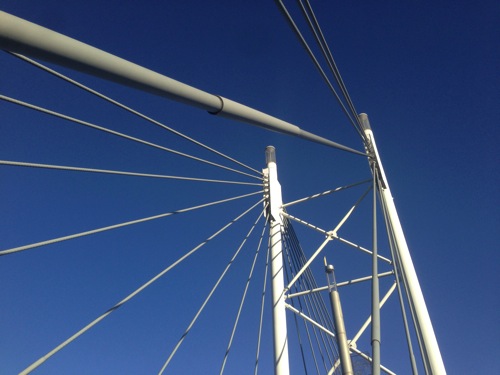
Today's worldwide Instawalk meets in Braamfontein. Its a special walk. Only my second, after the Fordsburg amble a few weeks ago, this one is very different. Part of the Worldwide Instawalk instigated by Instagram, it has  attracted photographers all the way from Pretoria. We even have a film crew to shoot a short film of the walk. I am happy to tag along, as I have wanted to shoot Nelson Mandela bridge at night, as well as the harder to reach parts of Newtown.
130407 Instawalk 1698
Nelson Mandela bridge
Last time it was only the four of us: me, Heather, Roy and Allessio from Pretoria. Today there are twenty people. I am finally meeting Uncle Scrooch and Gareth Pon, two of the movers and shakers of the Jozi Instagram scene. This is the first time my digital life spills into real life. I have never met most of these people, but because I follow their photo stream I know quite a bit about their lives.
130407 Instawalk 681
Almost gone
The crowd is homogenous: kids, hipsters, young couples. Mostly boys. I am the oldest person there by far. There is some delay as we wait for everyone to show up, and for the crew to set up their cameras.
130407 Instawalk 659
Daytime
When everyone is finally assembled, we walk across Nelson Mandela bridge in the late afternoon light. It's slow going, what with shooting the railway lines below us and the skyline on the opposite side. There is an element of wanting to get the best angle, the most interesting variation on a view, to 'see' a shot that no-one else has noticed. It's a competition of sorts. After a while everyone spreads out, looking for their own points of interest. When there is a good and easy shot, people cluster, but it's easy to get away. It's fun to look for the undiscovered scene.
130407 Instawalk 1733
Getting water from the street mains
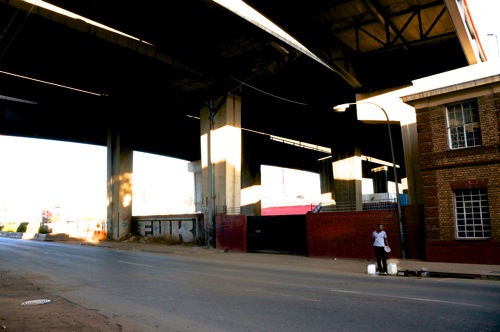
We walk down the ramp  into Newtown, past a building site with a lost house, an old villa teetering on the edge of the abyss that will one day be a mall. Cranes loom overhead. The motorway overpass edges the site, cars racing invisibly past. A little further a row of half-demolishd houses, a group of young men siphoning water off a broken mains, then we are in the warehouses of Newtown. A regeneration project of old factories, the area is now home to clubs and graffiti. In honour of the occasion we take a few group shots. Everyone is equipped with holi powder, and, positioned in front of a painted wall, we all jump. In between takes we all go back to shooting the small and the big, the unusual angle, the detail of the place. 
130407 Instawalk 705
getting ready for the jump
We return to Braamfontein via the bridge, catching the last of the great sunset light. Another photographer has the same idea, a fashion shoot is taking place across from us. A gaggle of girls and guys in skimpy outfits line up on the footpath, touching up make up and waiting their turn. It's a cheap and effective venue, with the colourful uplighters standing in for studio lighting and an unbeatable backdrop of the Jozi CBD. 
130407 Instawalk 1782
Night time
There is a video made by Gareth and Micklas on Vimeo:

More photos can be found in my Flickrstream:
You can find an overview of Jozi walks here, my account of a guided walk in Melville here, a Yeoville walk here, another account of instawalking here and my story of photowalking here.

05 May 2013

Hanging out with the elite of Kramerville

If you live in Joburg, you know of Sandton, the financial and shopping centre in the northern suburbs. It's very shiny, very white and very far away from the rest of the city. It's where all the banks and big business fled during the bad 80s and the mad 90s when the city centre turned in to a riot - literally - of protest, squatting and chaos. Sandton it's all shiny high rises and expensive bank lobbies congealing around the gleaming mall of Sandton City with its incongruous statue of Nelson Mandela wearing a Hawaiian shirt in the central square.

130407 Kramerville 1616
Trying on cool glasses
More on the weirdness of Sandton another time. Today the subject is Kramerville, a mini-destination just north of Sandton amongst the uber-leafy villas and secured compounds of the elite. My friend Heather is researching a book about Sandton, and after her initial trip dragged us out there to see how the other half lives. As most places in Jozi, it is a well-kept secret, a small proscribed area beyond which lie quiet streets of villas and other boring bits. Kramerville is actually a CID, a so-called 'city improvement district', which means that private money is brought in to carry out maintenance, security and communal improvements where the local council fails to do so. It means fences, rubbish-free streets and newly planted trees, but also fosters a closed-in exclusivity. A double-edged sword.

130407 Kramerville 1612

Our aim was to visit two locations in Kramerville, Three Desmond, an interior mall with a Sunday market, and Katy's, a newly-opened bar/cafe nearby. Three Desmond is a blob of furniture, interior design and ethnic shops. It is really a retail park, with warehouse-sized buildings, parking out front, security guards in uniform and high fences around each parcel of land. The clientele is super-posh, rich, expensive. Once a month there is a market at the main block, a vast terrace filled with traders selling everything from laser-cut earrings to hand-made leather bags, from trendy t-shirts to pottery knick-knacks. There is a bar for the grown-ups and a pottery wheel for kids. The shops in the main building exhibit cool and very expensive furniture, carpets and flooring.

130407 Kramerville 1619
Shop till you drop
The famous Mud studio has a big shop, selling its classic chandeliers made from recycled clay beads strung onto a wire framework. We saw them in London last year as part of the South Africa Olympics pavilion on the South Bank. Unlike most country pavilions for the Olympics the South Africans concentrated on community projects, development businesses, including Mud, which strives to empower its workers to become independent traders and set up in business rather than just working for them. The items on the shop here are quite cool: roughly handmade plates and bowls, mugs and pots, cast onto moulds and stamped in the back with the studio label and the individual maker: Daniel, Mketa, Doreen. I like the idea, but the items are crazy expensive. €18 for a dinner plate, €35 for a platter!

130407 Kramerville 633
A classic Mud chandelier
As we look around this trendy shopping orgy the place fills up with yummy mummies - and daddies, hipsters (there is a young guy flashing his analog Leica), stilletto-heeled Sandton babes, and wannabe outdoorsy guys. A neat-freak kid has been plonked by its mother on to the pottery wheel seat. The potter is showing her how to throw a bowl, but she is pulling faces, afraid to get red clay on her pink outfit. She can't be more than three. By the bannister, overlooking the valley of Sandton, two young black women sit on the deck, nibbling snacks and drinking champagne. Their legs delicately folded under them, they are trendy, skinny, at one with the crowd.

130407 Kramerville 1652

We visit the other place on Heather's list for lunch and drinks. Amatuli is a vast warehouse that has been turned into an ethnic furniture and deco shop. On two floors objects, photos and furniture from all corners of the undeveloped world are for sale. There are huge beaded arm chairs decorated with lions; silver Ethiopian coptic crosses mounted on wood blocks; black and white landscape photos framed in remnants of pressed steel ceilings; wooden Buddha heads, blown glass lampshades, stone carvings of fern leaves, bamboo bowls, filigree tin-cut head dresses… It's like the Pitt Rivers museum if everything there was for sale.

130407 Kramerville 1662

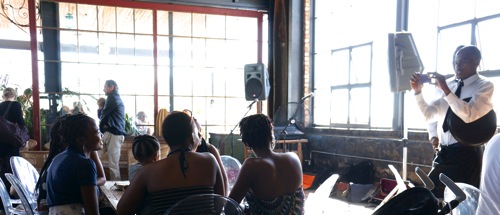
Upstairs reveals Katy's, a large open room filled with the good and beautiful of Sandton at lunch and Saturday drinks. Open to the skyline on one side and bordered by an upper level balcony on the other, wooden tables and elegant plastic chairs are spread round the large floor area. In one corner a two piece band noodles out average cover songs of REM and Coldplay, interspersed with original pieces of inspired fiddling and flute - until they are reduced to “It's a Beautiful World” and a terrible rendition of George Michael's “Faith” makes it time to leave.

130407 Kramerville 1680
The waiters are black - except for the white manager - but so is some of the very chic clientele, which makes me wonder if South Africa it isn't at that stage where it's down to economic status pure and simple, and talking about colour is really becoming a confusion, at least where places like the posh suburbs are concerned.

More photos from Kramerville at Flickr.


www.flickr.com

28 April 2013

Jozi walking part 4 - Joburg Places and Spaces

This is part 4 in a series on walking tours of Johannesburg. While other cities also offer guided tours, Jozi is unique in my mind as a place where people will group together, with or without a guide, to visit places that they normally wouldn't. Whether for safety in numbers, unfamiliarity or companionship, it's a thing here.

130406 CBD walk 105
Gerald, our tour leader, making a point
I met Gerald through my friend Heather. He is the author of the definitive Jozi guide - Joburg Places and Spaces 2.0. At long last I get to take part in one of his walking tours around the regenerated CBD. We meet in the current flavour of the month suburb of Braamfontein with its Neighbourgoods Market and the Lomo Gallery as well as an upmarket bike shop. It has everything a city borough needs to attract the better-off hip crowds of Joburg thirsty for new weekend venues: student bars, start-ups and refurbished condos.

130406 CBD walk 11
Neighbourgoods Market in Braamfontein
Grabbing some delicious biltong from the market we set for our six hour walk to see the CBD regeneration. Yes, six hours, but as Gerald points out, there are lots of opportunities to sit and listen to his story, or to gaze at the view, or to have a rest on the bus between destinations. The tour is offered most weekends, together with another walk from Newtown to Maboneng.

130406 CBD walk 19
Gerald explaining the layout of the CBD
Our tour today comprises of a German family whose son lives locally, a Portuguese couple of photographers - he lugs a tripod and heavy camera from shot to shot - and two older Jozi couples giving wistful insights into the history of their home town.
130406 CBD walk 46
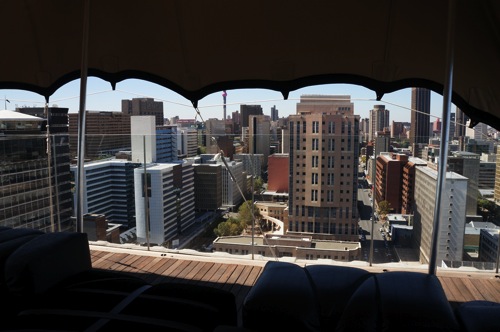
The view from Randlords
Before we set off Gerald gives us an introduction to Braamfontein, the CBD and general Joburg history. With the historical Kitchener's Hotel pub behind us and the freshly renovated Play Braamfontein store fronts in front of us, Gerald takes us through his theory of cities as microcosms of a country. The struggle for political power, for economic improvement, for cultural dominance, all this is played out all over South Africa, and in a concentrated form, in Joburg.

The view from the ladies - no, really!

We walk down the street to Randlords, one of the many private rooftop bars dotted around the city. The 22nd floor is one great window to the skyline, currently being set up for a wedding of hundreds. There is an elaborate deck with cushioned beds for lounging behind a glass bannister. There is even a swing for the playful-minded. The views south across the railway lines towards Newtown, east over the green suburbs to Brixton tower and the slag heap remnants of the gold mines, west to Hillbrow and the CBD are stunning, giving us a taste of what's to come.

130406 CBD walk 177
In the midst of the city
We meander our way through Braamfontein to the Rea Vaya bus stop at Park Station at the western end of Braamfontein for our drive to First National Bank in the heart of the city. The Rea Vaya, together with the Gautrain, are Joburg's latest addition to its frankly pathetic public transport system. This is a driving city, and if you can't afford a car, you are reduced to taking the crazy minibuses. They are dangerously driven, overcrowded and feel themselves above traffic rules, but they are cheap and run back and forth to Soweto. The Rea Vaya buses on the other hand have the potential to transform the public transport scene. They run on routes currently serviced by mini taxis, which made them controversial to set up (the mini taxi racket is highly profitable and tightly controlled by private bosses, which led to violent demonstrations, strikes and threats when the bus system was first implemented), but in its own pragmatic fashion the bus company has contracted the routes out to the former mini taxi owners, and employs the taxi drivers as bus drivers. There are still some problems, resulting in shiny new stations being boarded up while contracting disputes are resolved, but in the city at least the buses are running more or less on a schedule.

130406 CBD walk 141
Street trader selling peanuts and underpants
The bus arrives as soon as we get to the station, a cool sleek glass container with ticket barriers at either end. A sign tells us of all the activities that are not allowed at the station: no eating, no hawking, no waiting, no littering, no graffiti, no flyposting, no music, no smoking, no skate boarding, no guns, no dogs. One symbol of a hand is mystifying: No smacking? No waving? No gloves?

All the activities that are not allowed on the Rea Vaya


There is a smart card system in development, but for now we get paper tickets. The clean, new, fast bus (it runs in dedicated lanes through the CBDs grid) takes us downtown to the first of the regenerated areas. The Kerk Street development used to be a rough informal market street, but now has French-style open roofs for the traders and hair braiders stretched along the centre of the pedestrianised street. Both sides are lined with mainstream shops selling fashion like any other shopping street.

130406 CBD walk 116
Braiding supply shops
We stop at the bottom of the street next to a row of fruit and veg stalls to listen to Gerald explain the concept of public area regeneration. The premise is that since the council can't afford to renovate the whole CBD, it would improve the public areas to encourage private capital to come in and take over the run-down buildings. So far the city council has made good on the promise of making the streets of the CBD safer and more pleasant, and slowly businesses are moving back and transforming the dilapidated office blocks, many of which have previously been squatted. It's a huge struggle against the inertia of decay. Despite the new paving, the numerous pieces of street art, the pragmatic accommodation of informal traders, there are still plenty of potholes and broken kerbs. I see some of the grand old city buildings have been rescued or replaced with marble shininess, but there are still plenty of ruins with smoke-blackened window holes, graffiti-covered walls and boarded-up shop doorways. It's a long and slow process. 

130406 CBD walk 128
Hair braiders on Kerk Street
We proceed up Eloff street, once the fashionable shopping mall of the CBD with the most expensive properties, now slowly recovering. The new buildings of First National Bank nearby are bringing flush shoppers back into town. The kerbside is clogged with street stalls selling underpants and socks, bags of sweets and phone credit, cheap jewellery and pens. Women sit on wobbly stools having their hair braided.

130406 CBD walk 137
Markham's Department Store
We hear about the Markham building, an elaborate wrought-iron clock tower topping the oldest department store in the city, about the CNA headquarter, a once stylish five-storey corner block now boarded up and abandoned. We stop at the famous Rissick street post office, built by Paul Kruger to show the British that an Afrikaaner government could be as sophisticated as the Empire. Now a burnt-out shell after a 2009 fire, it was going to be demolished until a campaign to save the historic building forced a rebuilding project. At catty corners sits the grandly white Mutual Insurance building. Equally significant for its Edwardian building style, it, too, was going to be demolished, and will now be renovated and improved.

130406 CBD walk 167
Rissick Street Post Office
This is something of a theme: there seems to be absolutely no sense of architectural heritage here. Amazing historical buildings are simply abandoned until squatters make short work of the structure, and then pulled down to leave an empty lot that can only hope to survive as a parking lot, or have an anonymous glass and granite edifice parked on it. The CBD is filled with ugly sky scrapers from the bad old days of apartheid, the fatally style-deaf 70s have left their legacy, but there are also still some elegant Art Deco affairs, some late Victorian and Edwardian edifices of the Empire age, and some stylish 60s modernist blocks. No-one seems to think it important to preserve them.

Another intriguing architectural style, representative of 60s Apartheid paranoia
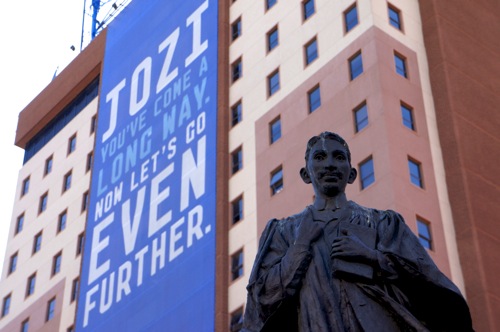
We have arrived in Gandhi Square, a large open space of bus ranks lined by lawyer's offices - the courts are nearby. Behind the bronze statue of the young Gandhi flutters a banner from the current council proclaiming:
 'Jozi, you've come a long way. Now let's go even further.'
130406 CBD walk 186
Gandhi would approve
Much of the regeneration of this historic square has come for the unlikely direction of a law firm (Olitzki) that took over many buildings in 1989 and has been involved in preserving both Gandhi's- he practiced law here before going to India to overthrow the British colonialists - and Mandela's offices - who also practiced law here before his arrest and imprisonment.

The regenerated Ernest Oppenheimer Park
Our walk ends at the Reef hotel, with the funky and cool Gold Reef Cafe on the ground floor. We take in one more sweeping view of the city, this time from an opposite vantage point of the earlier Randlords' view. Gerald takes us through the recent history of the city, explaining the seemingly sudden abandonment of the centre for the suburbs - and the new centre of Sandton. There was an element of self-destruction involved in the legal restrictions imposed by the Apartheid government to control the movements of the black majority. Laws to limit how many black workers an industrial businesses could employ if they had their factory in the city caused major problems. The number was six. With the introduction of the laws manufacturing businesses were forced to relocate. Large factories left the CBD, abandoning the southern area's industrial zone. Pass laws restricted blacks to homelands in rural areas, and only those  that had a job were allowed into the city. Since the factories were forced to move out, there was no access to the city for black workers or shoppers.

130406 CBD walk 193
Chilling on the rooftops
Then, in 1985, president Botha made a famously shocking speech called 'crossing the rubicon': in the face of international pressure instead of liberalising he clamped down on the anti-apartheid movement, made South Africa a military state, and declared a state of emergency. In expectation of the coming sanctions all international businesses left the city, leaving empty offices and ruined support businesses behind. At the same time the city workers left the northern city suburbs of Hillbrow and Yeoville, then bustling middle-class neighbourhoods, following the direction their workplaces had taken. Vast numbers of flats were unoccupied. Landlords keen to keep their income allowed flats to be occupied by poorer tenants, who turned to overcrowding to finance their new homes. The local municipality turned a blind eye because it disagreed with apartheid, allowing the deterioration of properties. In a few short years at the end of the 80s Jozi CBD turned from world metropolis into ravaged slum.

130406 CBD walk 112
A fashion afficionado in Kerk Street
We leave Gerald's tour here to return to Braamfontein, exhausted and enlightened in equal parts by this half day wander through the city. He will take the rest of the group on south and then return to Braamfontein by bus. I am left with a head buzzing with all the new impressions. It seems that every time I brave the CBD I see a new and fascinating part of it. There is the student hipness of Braamfontein, the cultural hub of Newtown, the hip lifestyle centre of Maboneng, the unjustly neglected art gallery and Joubert park. Now I can add the intriguing shopping streets of Kerk and Eloff streets.

You can find more photos in my Flickrstream.
www.flickr.com
You can find an overview of Jozi walks here, my account of a guided walk in Melville here, a Yeoville walk here, an account of instawalking here and my story of photowalking here