Showing posts with label people. Show all posts

05 May 2013

Hanging out with the elite of Kramerville

If you live in Joburg, you know of Sandton, the financial and shopping centre in the northern suburbs. It's very shiny, very white and very far away from the rest of the city. It's where all the banks and big business fled during the bad 80s and the mad 90s when the city centre turned in to a riot - literally - of protest, squatting and chaos. Sandton it's all shiny high rises and expensive bank lobbies congealing around the gleaming mall of Sandton City with its incongruous statue of Nelson Mandela wearing a Hawaiian shirt in the central square.

130407 Kramerville 1616
Trying on cool glasses
More on the weirdness of Sandton another time. Today the subject is Kramerville, a mini-destination just north of Sandton amongst the uber-leafy villas and secured compounds of the elite. My friend Heather is researching a book about Sandton, and after her initial trip dragged us out there to see how the other half lives. As most places in Jozi, it is a well-kept secret, a small proscribed area beyond which lie quiet streets of villas and other boring bits. Kramerville is actually a CID, a so-called 'city improvement district', which means that private money is brought in to carry out maintenance, security and communal improvements where the local council fails to do so. It means fences, rubbish-free streets and newly planted trees, but also fosters a closed-in exclusivity. A double-edged sword.

130407 Kramerville 1612

Our aim was to visit two locations in Kramerville, Three Desmond, an interior mall with a Sunday market, and Katy's, a newly-opened bar/cafe nearby. Three Desmond is a blob of furniture, interior design and ethnic shops. It is really a retail park, with warehouse-sized buildings, parking out front, security guards in uniform and high fences around each parcel of land. The clientele is super-posh, rich, expensive. Once a month there is a market at the main block, a vast terrace filled with traders selling everything from laser-cut earrings to hand-made leather bags, from trendy t-shirts to pottery knick-knacks. There is a bar for the grown-ups and a pottery wheel for kids. The shops in the main building exhibit cool and very expensive furniture, carpets and flooring.

130407 Kramerville 1619
Shop till you drop
The famous Mud studio has a big shop, selling its classic chandeliers made from recycled clay beads strung onto a wire framework. We saw them in London last year as part of the South Africa Olympics pavilion on the South Bank. Unlike most country pavilions for the Olympics the South Africans concentrated on community projects, development businesses, including Mud, which strives to empower its workers to become independent traders and set up in business rather than just working for them. The items on the shop here are quite cool: roughly handmade plates and bowls, mugs and pots, cast onto moulds and stamped in the back with the studio label and the individual maker: Daniel, Mketa, Doreen. I like the idea, but the items are crazy expensive. €18 for a dinner plate, €35 for a platter!

130407 Kramerville 633
A classic Mud chandelier
As we look around this trendy shopping orgy the place fills up with yummy mummies - and daddies, hipsters (there is a young guy flashing his analog Leica), stilletto-heeled Sandton babes, and wannabe outdoorsy guys. A neat-freak kid has been plonked by its mother on to the pottery wheel seat. The potter is showing her how to throw a bowl, but she is pulling faces, afraid to get red clay on her pink outfit. She can't be more than three. By the bannister, overlooking the valley of Sandton, two young black women sit on the deck, nibbling snacks and drinking champagne. Their legs delicately folded under them, they are trendy, skinny, at one with the crowd.

130407 Kramerville 1652

We visit the other place on Heather's list for lunch and drinks. Amatuli is a vast warehouse that has been turned into an ethnic furniture and deco shop. On two floors objects, photos and furniture from all corners of the undeveloped world are for sale. There are huge beaded arm chairs decorated with lions; silver Ethiopian coptic crosses mounted on wood blocks; black and white landscape photos framed in remnants of pressed steel ceilings; wooden Buddha heads, blown glass lampshades, stone carvings of fern leaves, bamboo bowls, filigree tin-cut head dresses… It's like the Pitt Rivers museum if everything there was for sale.

130407 Kramerville 1662

Upstairs reveals Katy's, a large open room filled with the good and beautiful of Sandton at lunch and Saturday drinks. Open to the skyline on one side and bordered by an upper level balcony on the other, wooden tables and elegant plastic chairs are spread round the large floor area. In one corner a two piece band noodles out average cover songs of REM and Coldplay, interspersed with original pieces of inspired fiddling and flute - until they are reduced to “It's a Beautiful World” and a terrible rendition of George Michael's “Faith” makes it time to leave.

130407 Kramerville 1680
The waiters are black - except for the white manager - but so is some of the very chic clientele, which makes me wonder if South Africa it isn't at that stage where it's down to economic status pure and simple, and talking about colour is really becoming a confusion, at least where places like the posh suburbs are concerned.

More photos from Kramerville at Flickr.


www.flickr.com

28 April 2013

Jozi walking part 4 - Joburg Places and Spaces

This is part 4 in a series on walking tours of Johannesburg. While other cities also offer guided tours, Jozi is unique in my mind as a place where people will group together, with or without a guide, to visit places that they normally wouldn't. Whether for safety in numbers, unfamiliarity or companionship, it's a thing here.

130406 CBD walk 105
Gerald, our tour leader, making a point
I met Gerald through my friend Heather. He is the author of the definitive Jozi guide - Joburg Places and Spaces 2.0. At long last I get to take part in one of his walking tours around the regenerated CBD. We meet in the current flavour of the month suburb of Braamfontein with its Neighbourgoods Market and the Lomo Gallery as well as an upmarket bike shop. It has everything a city borough needs to attract the better-off hip crowds of Joburg thirsty for new weekend venues: student bars, start-ups and refurbished condos.

130406 CBD walk 11
Neighbourgoods Market in Braamfontein
Grabbing some delicious biltong from the market we set for our six hour walk to see the CBD regeneration. Yes, six hours, but as Gerald points out, there are lots of opportunities to sit and listen to his story, or to gaze at the view, or to have a rest on the bus between destinations. The tour is offered most weekends, together with another walk from Newtown to Maboneng.

130406 CBD walk 19
Gerald explaining the layout of the CBD
Our tour today comprises of a German family whose son lives locally, a Portuguese couple of photographers - he lugs a tripod and heavy camera from shot to shot - and two older Jozi couples giving wistful insights into the history of their home town.
130406 CBD walk 46
The view from Randlords
Before we set off Gerald gives us an introduction to Braamfontein, the CBD and general Joburg history. With the historical Kitchener's Hotel pub behind us and the freshly renovated Play Braamfontein store fronts in front of us, Gerald takes us through his theory of cities as microcosms of a country. The struggle for political power, for economic improvement, for cultural dominance, all this is played out all over South Africa, and in a concentrated form, in Joburg.

The view from the ladies - no, really!

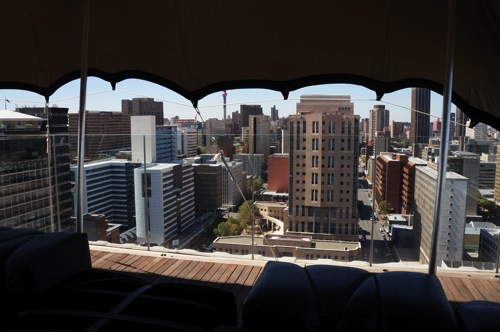
We walk down the street to Randlords, one of the many private rooftop bars dotted around the city. The 22nd floor is one great window to the skyline, currently being set up for a wedding of hundreds. There is an elaborate deck with cushioned beds for lounging behind a glass bannister. There is even a swing for the playful-minded. The views south across the railway lines towards Newtown, east over the green suburbs to Brixton tower and the slag heap remnants of the gold mines, west to Hillbrow and the CBD are stunning, giving us a taste of what's to come.

130406 CBD walk 177
In the midst of the city
We meander our way through Braamfontein to the Rea Vaya bus stop at Park Station at the western end of Braamfontein for our drive to First National Bank in the heart of the city. The Rea Vaya, together with the Gautrain, are Joburg's latest addition to its frankly pathetic public transport system. This is a driving city, and if you can't afford a car, you are reduced to taking the crazy minibuses. They are dangerously driven, overcrowded and feel themselves above traffic rules, but they are cheap and run back and forth to Soweto. The Rea Vaya buses on the other hand have the potential to transform the public transport scene. They run on routes currently serviced by mini taxis, which made them controversial to set up (the mini taxi racket is highly profitable and tightly controlled by private bosses, which led to violent demonstrations, strikes and threats when the bus system was first implemented), but in its own pragmatic fashion the bus company has contracted the routes out to the former mini taxi owners, and employs the taxi drivers as bus drivers. There are still some problems, resulting in shiny new stations being boarded up while contracting disputes are resolved, but in the city at least the buses are running more or less on a schedule.

130406 CBD walk 141
Street trader selling peanuts and underpants
The bus arrives as soon as we get to the station, a cool sleek glass container with ticket barriers at either end. A sign tells us of all the activities that are not allowed at the station: no eating, no hawking, no waiting, no littering, no graffiti, no flyposting, no music, no smoking, no skate boarding, no guns, no dogs. One symbol of a hand is mystifying: No smacking? No waving? No gloves?

All the activities that are not allowed on the Rea Vaya


There is a smart card system in development, but for now we get paper tickets. The clean, new, fast bus (it runs in dedicated lanes through the CBDs grid) takes us downtown to the first of the regenerated areas. The Kerk Street development used to be a rough informal market street, but now has French-style open roofs for the traders and hair braiders stretched along the centre of the pedestrianised street. Both sides are lined with mainstream shops selling fashion like any other shopping street.

130406 CBD walk 116
Braiding supply shops
We stop at the bottom of the street next to a row of fruit and veg stalls to listen to Gerald explain the concept of public area regeneration. The premise is that since the council can't afford to renovate the whole CBD, it would improve the public areas to encourage private capital to come in and take over the run-down buildings. So far the city council has made good on the promise of making the streets of the CBD safer and more pleasant, and slowly businesses are moving back and transforming the dilapidated office blocks, many of which have previously been squatted. It's a huge struggle against the inertia of decay. Despite the new paving, the numerous pieces of street art, the pragmatic accommodation of informal traders, there are still plenty of potholes and broken kerbs. I see some of the grand old city buildings have been rescued or replaced with marble shininess, but there are still plenty of ruins with smoke-blackened window holes, graffiti-covered walls and boarded-up shop doorways. It's a long and slow process. 

130406 CBD walk 128
Hair braiders on Kerk Street
We proceed up Eloff street, once the fashionable shopping mall of the CBD with the most expensive properties, now slowly recovering. The new buildings of First National Bank nearby are bringing flush shoppers back into town. The kerbside is clogged with street stalls selling underpants and socks, bags of sweets and phone credit, cheap jewellery and pens. Women sit on wobbly stools having their hair braided.

130406 CBD walk 137
Markham's Department Store
We hear about the Markham building, an elaborate wrought-iron clock tower topping the oldest department store in the city, about the CNA headquarter, a once stylish five-storey corner block now boarded up and abandoned. We stop at the famous Rissick street post office, built by Paul Kruger to show the British that an Afrikaaner government could be as sophisticated as the Empire. Now a burnt-out shell after a 2009 fire, it was going to be demolished until a campaign to save the historic building forced a rebuilding project. At catty corners sits the grandly white Mutual Insurance building. Equally significant for its Edwardian building style, it, too, was going to be demolished, and will now be renovated and improved.

130406 CBD walk 167
Rissick Street Post Office
This is something of a theme: there seems to be absolutely no sense of architectural heritage here. Amazing historical buildings are simply abandoned until squatters make short work of the structure, and then pulled down to leave an empty lot that can only hope to survive as a parking lot, or have an anonymous glass and granite edifice parked on it. The CBD is filled with ugly sky scrapers from the bad old days of apartheid, the fatally style-deaf 70s have left their legacy, but there are also still some elegant Art Deco affairs, some late Victorian and Edwardian edifices of the Empire age, and some stylish 60s modernist blocks. No-one seems to think it important to preserve them.

Another intriguing architectural style, representative of 60s Apartheid paranoia
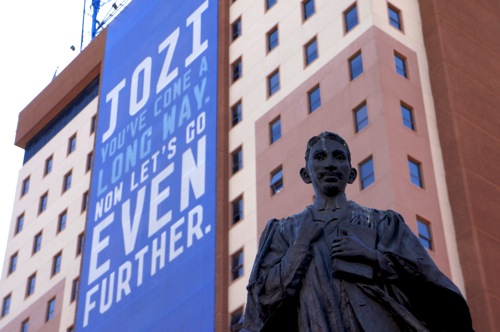
We have arrived in Gandhi Square, a large open space of bus ranks lined by lawyer's offices - the courts are nearby. Behind the bronze statue of the young Gandhi flutters a banner from the current council proclaiming:
 'Jozi, you've come a long way. Now let's go even further.'
130406 CBD walk 186
Gandhi would approve
Much of the regeneration of this historic square has come for the unlikely direction of a law firm (Olitzki) that took over many buildings in 1989 and has been involved in preserving both Gandhi's- he practiced law here before going to India to overthrow the British colonialists - and Mandela's offices - who also practiced law here before his arrest and imprisonment.

The regenerated Ernest Oppenheimer Park
Our walk ends at the Reef hotel, with the funky and cool Gold Reef Cafe on the ground floor. We take in one more sweeping view of the city, this time from an opposite vantage point of the earlier Randlords' view. Gerald takes us through the recent history of the city, explaining the seemingly sudden abandonment of the centre for the suburbs - and the new centre of Sandton. There was an element of self-destruction involved in the legal restrictions imposed by the Apartheid government to control the movements of the black majority. Laws to limit how many black workers an industrial businesses could employ if they had their factory in the city caused major problems. The number was six. With the introduction of the laws manufacturing businesses were forced to relocate. Large factories left the CBD, abandoning the southern area's industrial zone. Pass laws restricted blacks to homelands in rural areas, and only those  that had a job were allowed into the city. Since the factories were forced to move out, there was no access to the city for black workers or shoppers.

130406 CBD walk 193
Chilling on the rooftops
Then, in 1985, president Botha made a famously shocking speech called 'crossing the rubicon': in the face of international pressure instead of liberalising he clamped down on the anti-apartheid movement, made South Africa a military state, and declared a state of emergency. In expectation of the coming sanctions all international businesses left the city, leaving empty offices and ruined support businesses behind. At the same time the city workers left the northern city suburbs of Hillbrow and Yeoville, then bustling middle-class neighbourhoods, following the direction their workplaces had taken. Vast numbers of flats were unoccupied. Landlords keen to keep their income allowed flats to be occupied by poorer tenants, who turned to overcrowding to finance their new homes. The local municipality turned a blind eye because it disagreed with apartheid, allowing the deterioration of properties. In a few short years at the end of the 80s Jozi CBD turned from world metropolis into ravaged slum.

130406 CBD walk 112
A fashion afficionado in Kerk Street
We leave Gerald's tour here to return to Braamfontein, exhausted and enlightened in equal parts by this half day wander through the city. He will take the rest of the group on south and then return to Braamfontein by bus. I am left with a head buzzing with all the new impressions. It seems that every time I brave the CBD I see a new and fascinating part of it. There is the student hipness of Braamfontein, the cultural hub of Newtown, the hip lifestyle centre of Maboneng, the unjustly neglected art gallery and Joubert park. Now I can add the intriguing shopping streets of Kerk and Eloff streets.

You can find more photos in my Flickrstream.
www.flickr.com
You can find an overview of Jozi walks here, my account of a guided walk in Melville here, a Yeoville walk here, an account of instawalking here and my story of photowalking here

22 April 2013

An Easter outing

We pick up Heather at 9am. The sun is blazing, the long weekend is upon us, it's time to get out of town. Hartebespoort Dam is easy to get to, so that's our aim for today. Everyone else seemed to have the same idea, so the little town is busy by the time we get there, the main road clogged with visitors. As the closest resort to both Jozi and Pretoria, Hartebespoort consists of holiday homes and retirement communities. It's all very Afrikaans, as Heather points out, although I can't really tell, a white South African looks like another to me.

130330 Hartebespoort Dam and Pretville outing 501
The signs of autumn are upon us
We have two destinations in mind today, perfect and easily digestible both: the newly renovated cablecar going up the Magaliesberg and the film set of the comedy musical Pretville (Afrikaans link).

Hartie's Cable Car

Cable car first, to avoid the after lunch crush. But when we get there, a queue is already building, the car park full of SUVs and bakkies. Stuart gets tickets while we start queuing up the stairs. The lift was built in 1973 with Swiss equipment and know-how, but closed down in the 80's, only re-opening last year. It's a pretty nice renovation, with a few shops and cafes, clean toilets and an organised system to maximise passengers. A ticket collector checks the queue to match groups to always fill each carriage with six people. Everyone is happy to jump the queue. We wind our way up the ramp until we enter the station hall, a big room open at the end where the carriages slide in and out on overhead wires.

130330 Hartebespoort Dam and Pretville outing 1209

The lift cars are small, green and glassed in. They keep moving as passengers get out and in. We have to swap seats to balance each other's weight, then the car slides off with a big whoosh like a fairground ride. Suddenly, at great speed, we are above the car park, and then above the wild hills. Underneath is a thicket of green trees, red earth, yellow rocks. We gain height and the valley unfolds below us. In the distance the green-blue of the dam blazes in the sun. Behind it low hills point the way to Joburg, while to our right and left the eroded slopes of the Magaliesberg step away from us in geometric uniformity. Below me I can make out a thin path winding uphill. Above me the slack lines of the cable connection hold us in the air.


The threesome opposite us, a couple and their lady friend visiting form Cape Town, smile at our excited exclamations at the view. The visitor was not impressed. Having the table mountain cable car on your doorstep, this must be a comedown. I am intrigued: by the sheer cliffs we pass and the trees growing stubbornly out of a tiny crack in the rocks; by the possibility of seeing animals; by the loud fresh green against the harsh dry red soil.

130330 Hartebespoort Dam and Pretville outing 1294

The ride is over too soon, and we step off the moving cart at the top station. A walkway guides us around and up the hill with pointers along the way. It's hot, with children jostling to climb the rocks on the edge of the hill, nervous parents holding on to their hands to prevent fatal falls. Haartebespoort spreads below us in a hot haze. We can just make out the sailing marina, the main road and blotches of retirement estates.

Pretville

130330 Hartebespoort Dam and Pretville outing 1368
Pretville's hairdresser set

Next we backtrack to Pretville, the film set for a 50s Afrikaans musical. It's an incongruous place, a fake ice-cream coloured confection used to film an all-singing, all-dancing spectacle of history white-washing. While the Group Areas Act was being designed to force families from their homes, the diner served milk shakes and the pharmacy treated babies with colic.


An innocuous-looking police car is parked in the square, dinky and cute. I have the overwhelming sense that it is missing a black offender of the pass laws in the back. The car repair shop lacks an oily labourer, and the tiny prison tucked away behind the children's clothing store really should have been staffed with ANC supporters. The place feels like a lie, all of us white people (unlike the cable car, there are no actual black faces at Pretville) wandering about this movie-glossed version of a reality that never was.

130330 Hartebespoort Dam and Pretville outing 1458
the sweet shop
Unlike the photos in a photo book I saw recently, where the poverty of mind and life, the harsh conditions of the Karoo, the wiry stubbornness and hateful relationships with blacks was clear and unmistakeable, here all the issues have just been airbrushed out of the picture. I guess the 50s in South Africa is just not a a historical period that lends itself to bubblegum entertainment.

130330 Hartebespoort Dam and Pretville outing 1469

On the way home, by way of irony, we passed Diepsloot, one of the biggest 'informal settlements' just north of Joburg. This woman was cutting straw from a fallow field across the township to sell as roofing material. No pink here.

You can see more photos on Flickr:


www.flickr.com

19 December 2009

Egypt Roundup

Day 152 to 159 - Aswan - 075

I think this will be my last roundup covering just one country, as we are now picking up the speed for the last leg through the Middle East and back to Europe. As you might have noticed, we have found ourselves suddenly tacking on a whirlwind tour of the Eastern Mediterranean, mainly due to our newly acquired horror of ferry journeys (I write this on the Nuweiba-Aqaba ferry, having experienced another fine example of streamlined government processes while leaving).

Anyway, Egypt. Or should I say, Aswan, as we spent the bulk of our time there. Being pedestrians once again has been a new experience. We had to catch taxis and buses (and boats), which was not always a bad thing. The public bus to Abu Simbel turned out to be almost fun (as much fun as a three hour drive through a flat sand desert can be) with our breakfast box provided by the hotel and plenty of reading matter imported by Alex. Yes, Alex has joined us, and fitting right in, has become holder of the kitty and chef extraordinaire. We are now three again, and it feels good.

Day 163-7 - Aswan - 101

Being in one place had other advantages, specially somewhere like Aswan where most interaction between foreigners and locals is reduced to the level of selling/buying tourist goods and services. After a few days of passing the same spot the spice seller stopped offering his wares and started joking, the fellucca captains took us for granted and the souq touts offered karkady rather than hassling us. We started telling people we were Nubians from Aswan and found that behind the intense selling pitch were a bunch of friendly, hospitable and interesting people.

Day 168 - Aswan to Eastern Desert via Karnak - 108

Egypt was, obviously, temples and tombs and ruins and pyramids. It was the magnificent temple at Karnak, where ruins are being reassembled by crane, to the envy of the pharaohs watching from the hereafter; it was hard sell from the guides and postcard sellers at every location, hordes of bus tourists crowding the sites and all the tack not being able to overshadow the bombast of Ramses II who was obviously so insecure that he needed colossi in his own image and self portraits as he smites his enemies and pals with the gods.

Day 168 - Aswan to Eastern Desert via Karnak - 086

There were not as many temple visits as I’d liked, but they will have to wait for another time. Instead Egypt turned out to be about making new friends and meeting old ones: It was getting behind the facade and discovering a fellucca captain concerned with his colleagues’ hardline sales patter ruining business for all of them; a fixer who hates the local bureaucracy that is making his job of getting overlanders across the border so unpleasant; a waiter who loves the kitten that hangs around the restaurant tables begging for scraps, the hotel clerk who made sure we always knew the real price for things so we wouldn’t get ripped off. It was days and days of doing absolutely nothing, wandering from hotel roof terrace to Corniche to waterside restaurant, waiting for the day to end so that maybe, tomorrow, Inshallah, there would be news of the car. Eventually it was the battle with Egyptian bureaucracy, which everyone had told us was ridiculous, but which we never in our wildest nightmares could have imagined to be this inefficient. It was finally leaving Aswan, back on the open road, and driving, driving all day, the Nile passing by, people passing by, desert passing by and not stopping ever again.

Photos are here.

14 December 2009

Leaving Aswan


Day 160 - Felucca Ride Aswan - 032

After two weeks of idling, waiting for the car to catch up with us, it was surprisingly hard to leave Aswan. We had found favourite haunts for dinner, sunset watching and beer drinking, we had made connections: Mahmoud, keeping us up to date with the non-progress of the barge that - Inshallah - would bring our car; Shahad, fellucca captain extraordinaire and his brother Shazy, hospitable Nubians serving karkady (hibiscus tea) on his boat; Mohammed from the Keylany Hotel reception, dispenser of information and correct pricing for all manner of things, and Hamid and his three brothers, wily sellers of tourist tack in the souq, who could also arrange for the sale of anything else required.

Still, the most friendly encounters since we left Sudan took place on our way out of the tourist metropolises of Luxor and Aswan. Attempting to buy bread, we stopped at a falafel cafe in a small village, where my request for “Eish" (my Arabic is obviously coming along in leaps and bounds) resulted in a group discussion by all other customers until we found an English speaker, who, after giving me a big bag of freshly fried bright green falafel, initially refused my attempt at payment, and eventually accepted a few Euros worth of Egyptian Pounds for six flatbreads, 25 falafel and a bag of tomatoes.


Day 163-7 - Aswan - 083

Later, looking for crisps and water at a roadside shop near Qena, my miserable Arabic had everyone falling about laughing. The shopkeeper eventually rescued me with stern looks in the direction of his son and daughter, who were wrestling over the privilege of packing my purchases into a bag. For some reason everything I did, pointing to things, getting out my money, even just standing there shrugging my shoulders, made them collapse into heaps of giggles. It still makes me smile now.

We stopped for lunch on a side road, and after convincing the soldiers at the road block - there is a road block at every junction on the Nile Road - that we were not going to get ourselves blown up or machine-gunned on their watch, we ate those lovely falafel with sweet chilli sauce, made all the more tasty by the fact that not one passer-by stopped to stare, and the old man over the road cutting fodder never even threw us a glance. Just as we got ready to leave a young man stopped his donkey cart next to our car and wandered off into a palm grove. He returned a few minutes later with a handful of fresh dates, just picked and thick with honey sweetness, which he offered us, smiling. Asking nothing in return, he got back onto his cart, waved and disappeared.

12 December 2009

How to ... Get your car out of customs in Egypt

We managed to extract the car from Egyptian customs, but only after witnessing the most flamboyant display of ineptitude, corruption and disorganisation so far on this trip.


Day 163-7 - Aswan - 036

The setting: Aswan’s ferry port, witness to weekly passenger ferries and occasional cargo barges from and to Wadi Halfa in Sudan, and a suburban hellhole complete with sewage repairs and begging children, site of the Aswan traffic police department.

The actors: various overlanders, both amateurs like us and professional drivers of overland trucks; M., the fixer extraordinaire; K., his slow-witted taxi driver (employed by M. only because his uncle is the head of the customs department); a near-blind customs official and assorted policemen on the hunt for baksheesh.

The mission: to convince Egyptian customs, traffic police and various other unmentioned government agents to release nine cars and trucks from the customs zone of the ferry port so that we can bloody well finish our journey.

The backstory: most of us have been waiting to move on for more than two weeks, variously in Aswan, Wadi Halfa and assorted locations in the Sudanese desert. The barge carrying the cars (which runs on a separate schedule from the passenger ferry) was delayed due to Eid, weekends (Fridays) and other unexplained vagaries of Arabic origin. The barge had arrived on Thursday afternoon, complete with five Landrovers, two overland trucks, one MAN truck and a Landcruiser, as well as three dogs. It was now Saturday. Everyone was tense in a different way, everyone wanted to get out of Aswan as soon as possible.


Day 163-7 - Aswan - 074

The timeline:

8am - waiting for K. and a second taxi driver to pick us up. Fourteen people sizing each other up at the hotel; I don’t like what I see. Two stroppy Australians and a South African motorbiker who has been heard to call the locals kaffirs. Great.

8.30 - The taxis arrive. We drive to the police station. K. and two members of the group disappear inside with carnets, passports and money. The rest of us get acquainted while leaning on the bonnets of banged-up taxis (ours has done 750,000 km). The Dragoman driver is reading the Daily Express. She must be homesick.

9.30 - The others re-appear, the grand total of their achievements a collection of blank forms in Arabic. We pile back into the cars and take the bumpy road to the port.

10am - Arrival at the ferry port. K. takes the first group through to the offices, while we in the second group are left behind to fend off baksheesh attempts by the gate keeper, who is trying to charge us to pick up our cars.

11am - After a series of phone calls to M. and strong words with the various fixers he sends, we are let into the office as well. We spend an eternity watching the near-blind official painstakingly copying driver names, chassis numbers and registrations from the English forms to the Arabic version. This takes two hours for nine carnets, with multiple breaks for tea and smokes.


Day 163-7 - Aswan - 075

12.30 - The barge is now available, sort of. M. has managed to convince the crew that just because the normal pier is blocked by the Minister of Agriculture’s boat (he is returning from a visit to Sudan, and seen speeding off in a very shiny black Merc), we should still be able proceed with unloading. So in order to drive the cars off the barge, we have to manhandle the strangely engine-less craft to shore by all together pulling on a rope, while the captain and his crew shouts encouragement. Taking the trucks and cars off takes a grand total of 15 minutes.

1.30pm - We are still waiting in the port car park for something to happen. M. brings tea. Suddenly a customs official appears, spends 2 minutes peering through the door of each car, asking if we have knives (?!?), and vanishes. Silence returns. We haven’t had lunch. In desperation I spend some time cleaning the fridge and kitchen in our Landrover.

2.30pm - A policeman, ferried in by K. for the occasion, takes rubbings of our chassis and engine numbers before demanding payment for overtime. After collecting E£10 per car he is taken back to town by K. and ennui descends one more.

3pm - We are told to come back tomorrow to complete formalities, as the traffic police has gone home. Aargh!


Day 163-7 - Aswan - 060

The denouement: Stuart spent all of Sunday at the traffic police to arrange insurance and registration. He was finally allowed to leave, sporting Egyptian number plates, after yet another official tried to extract a bribe for not doing a proper check. Our fixer, to his credit, called his bluff and told him they’d be happy to unpack the cars so he could do a more thorough search. Luckily the official decided he valued knocking off on time more than the money and let them depart at 4pm.

10 December 2009

How to ... Do Nothing in Aswan

We’ve been here for nigh on two weeks now, and while Aswan has many attractions (Temple of Isis! Nubian Museum! Tombs of the Nobles!), two weeks is a long time to be waiting for your car to arrive (and your spare clothing, and, yes, stationery - I can’t last long without my stationery bag). But we are still here, so I thought I’d give you an insight into our day and how we stave off boredom:

9.30am - Roll out of bed and climb up to the roof terrace for breakfast - it’s the same every day but at least you don’t need to brave the streets in search of nourishment. We have pancakes and fruit, lemonade, tea, toast with butter and jam and triangles of cream cheese. It took us a few days of trying to change some parts of the order (cold milk instead of hot, scrambled eggs with the toast) to realise that it’s not worth the trouble explaining this to the Manuel-like waiter every morning. Now we just eat what we’re given. Thanks to Alex we have a supply of magazines to read over breakfast, and there is wifi internet, so Stuart can get his fix of email.

11am - If the weather is hot (not that it’s ever really cold, but on occasion we’ve had cloud and the temperature drops to a chilly 20C) someone might sunbathe on one of the two loungers, and there is even the possibility of jumping in the plunge pool on the roof. It’s freezing, so perfect for an overheated holiday maker. The roof terrace sits above the busy Salah-en-Din Road, so there is an orchestra of toots and shouts to listen to. It’s easy to while away most of the morning here.

DSC00168.JPG

1pm - We are rationing ourselves to one item of touristing a day, so by this time we may get on the ferry to the west bank of the Nile for a visit to the Tombs of the Nobles, or take a fellucca boat to visit the botanical gardens at Kitchener Island. It’s not hot through the day, so practically any amount of wandering round ruins is still a pleasant activity. Unfortunately going to a tourist attraction always involves a huge amount of bargaining with the local 'business men’, fellucca captains or ferry ticket sellers, guides and assorted vendors of food and tack. It’s still hard work, even after our varied experiences throughout Africa, and here bargaining is much more a normal part of the day, unlike further south, where bargaining is mostly part of the tourism infrastructure (i.e. locals pay a fixed price and mzungus/faranjis are charged as much as possible). So we tend to start with a certain amount of hesitation, because we know that the first price we are quoted will be massively inflated compared to the prices charged to locals. Still, with a bit of good humour we normally manage to keep relations civil, and we spend a few hours acting as if we were the average tourist.

DSC04267.JPG

4pm - Hunger sets in. We seem to manage with two meals a day here, which might be due to the climate or just that we don’t actually do anything all day. Whatever, we retire to our local haunt, the Aswan Moon, discovered after a thorough investigation of the local eateries (we tried two other ones before settling on this one). The restaurant is set partly on the bank and partly on a pontoon set on the river. A fabric-covered awning keeps out the sun, so it’s a good place to spend the rest of the afternoon till sunset, watching the felluccas pass by, herons coming in to land and generally admire the light on the sand dunes on the other bank where they are not obscured by the hideous construct of the Mövenpick Hotel on Elephantine Island. Our late lunch consists of lentil soup with a squeeze of lemon, grilled chicken with rice, hummus, babaganoush and flatbread, strawberry juice and Om Ali for desert followed by a Turkish coffee. We have learnt to spin this out until it’s dark, chatting with the waiter or Shahad, the fellucca captain, and sometimes we get a visit from Mahmoud, who is arranging for the car to get here from Wadi Halfa (Inshallah) and who regularly gives us updates that turn out to be incorrect.  

DSC04188.JPG

7pm - Back to the hotel to watch movies (thanks to the blessings of iTunes, Pirate Bay and the hotel’s fast internet connection). There is more tea drunk while sprawled on the bed in the room, eating the chocolate Alex brought from England - thanks, Alex! Early nights are a given, since there are so many reasons to get up in the morning - not.

04 December 2009

Sudan Roundup


DSC03665.JPG

Sudan was country number 10. We well and truly left Africa and returned to the more familiar bosom of the Arab World. It was pleasant to be somewhere familiar after the sweaty otherness of East Africa and the complete alien culture of Ethiopia. To be honest, we raced through Sudan, despite being given a four week pass. There are no ATMs in Sudan, so we had limited amounts of money to spend, plus we had to catch an earlier ferry than we had planned due to the Eid al Ahra holiday. We entered Sudan halfway upcountry with the Nile, took two long driving days to Khartoum, spend a few days in Khartoum and a few dawdly days more or less following the Nile north to the edge of Lake Nasser, seeking out the remains of the Kushite empire. Then we left on the adventure that is the Wadi Halfa ferry.


DSC03567.JPG

From Ethiopia the terrain changed completely. After weeks of cool and populated mountains we were back at 500 m altitude and a landscape that is endlessly flat and monotonously yellow and red. The soil is a fertile dark brown where it is irrigated, vast harvested fields running to the horizon. Northwards desert proper begins, black rockscapes on fine red sand. The Nile winds its way through this barrenness, providing a sweep of green and blue in the monotony. Alongside its water life is possible, endless stretches of habitation reliant on the fields and date farms kept alive by pumps and donkey power. Always within reach of the river, but separate, set into the silence of the sands, temples and pyramids of the Kushite civilisation. Rulers of Nubia and for a while, Egypt, the Kushites left sandblasted ruins which German archaeologists are attempting to rescue before they fade into the desert. Pointy pyramids modelled on Giza (but smaller, steeper and altogether different, as if the blueprints were transmitted by Chinese whispers) erupt by the side of the road along with exquisitely decorated temples proclaiming the superiority of the local kings and queens.


DSC03739.JPG

Sudan was big earthenware jugs provided as a public water supply, regular features of the road; low mud brick houses enclosed by decorated walls to keep out wind and sand; heat making the asphalt glassy and reflective like a mirror held up to the scorching sky, oncoming trucks wavering in the mirage, seemingly floating. It was camping in the desert again at last, solitude and stars galore, just as soon as we found a place where we wouldn’t get stuck. It was good roads (built by the Chinese to access Sudan’s natural resources, as in Ethiopia), allowing us to drive all day and make good distance. It was also the worst possible traffic snarl I have ever encountered, proving that Khartoum is up there with Dubai, Nairobi and Chennai, filled with lunatic drivers. Sudan was too short (don’t I say that about all our countries?), but it made a powerful impression.


DSC00025.JPG

While the panorama was unchallenging to our desert-proven eyes, our human encounters offered unexpected surprises: There was Ahmed the assured money changer in Wad Madani’s gold souq, dispensing cash and foul with equal aplomb; hospitable Magdi at Wadi Halfa who put us up in his new house for the duration; the casual acquaintance we encountered at the petrol station out of Khartoum, who invited us to stay with him for a few days - another time maybe! Such kindness, such honesty and simple friendliness. After the incessant press of people in East Africa and before the anticipated rapaciousness of the Egyptians, what a breath of fresh air to be treated like friends.


DSC04036.JPG

And then there were the variously vehicled overlanders we came across: American cyclists Mary and Greg, the Irish bike riders who insisted on completing their Cairo to Cape (or rather Addis to Cape, then fly back to Addis to cycle to Cairo), the Belgian boys on their way South, eager for GPS co-ordinates and information on road conditions, and fortuitously, on the roadside, Monty the Landrover, whose blog is giving us all the info we need to get through Egypt and onwards. Not to forget the crowd of Algerian footie supporters before and after their victory over Egypt, a nicer group of sober football fans you couldn’t hope to meet.


DSC03746.JPG

It feels as if Africa is over, and we are entering a new phase in our journey. We have acquired a new travel companion and decided to brave the Middle East route rather than the ferry to Italy, so the drive onwards will be both longer and more interesting. Of course, as of today we are still carless, so right now we are not going anywhere, but as soon as we do, you will know all about it.