Showing posts with label shopping. Show all posts

05 May 2013

Hanging out with the elite of Kramerville

If you live in Joburg, you know of Sandton, the financial and shopping centre in the northern suburbs. It's very shiny, very white and very far away from the rest of the city. It's where all the banks and big business fled during the bad 80s and the mad 90s when the city centre turned in to a riot - literally - of protest, squatting and chaos. Sandton it's all shiny high rises and expensive bank lobbies congealing around the gleaming mall of Sandton City with its incongruous statue of Nelson Mandela wearing a Hawaiian shirt in the central square.

130407 Kramerville 1616
Trying on cool glasses
More on the weirdness of Sandton another time. Today the subject is Kramerville, a mini-destination just north of Sandton amongst the uber-leafy villas and secured compounds of the elite. My friend Heather is researching a book about Sandton, and after her initial trip dragged us out there to see how the other half lives. As most places in Jozi, it is a well-kept secret, a small proscribed area beyond which lie quiet streets of villas and other boring bits. Kramerville is actually a CID, a so-called 'city improvement district', which means that private money is brought in to carry out maintenance, security and communal improvements where the local council fails to do so. It means fences, rubbish-free streets and newly planted trees, but also fosters a closed-in exclusivity. A double-edged sword.

130407 Kramerville 1612

Our aim was to visit two locations in Kramerville, Three Desmond, an interior mall with a Sunday market, and Katy's, a newly-opened bar/cafe nearby. Three Desmond is a blob of furniture, interior design and ethnic shops. It is really a retail park, with warehouse-sized buildings, parking out front, security guards in uniform and high fences around each parcel of land. The clientele is super-posh, rich, expensive. Once a month there is a market at the main block, a vast terrace filled with traders selling everything from laser-cut earrings to hand-made leather bags, from trendy t-shirts to pottery knick-knacks. There is a bar for the grown-ups and a pottery wheel for kids. The shops in the main building exhibit cool and very expensive furniture, carpets and flooring.

130407 Kramerville 1619
Shop till you drop
The famous Mud studio has a big shop, selling its classic chandeliers made from recycled clay beads strung onto a wire framework. We saw them in London last year as part of the South Africa Olympics pavilion on the South Bank. Unlike most country pavilions for the Olympics the South Africans concentrated on community projects, development businesses, including Mud, which strives to empower its workers to become independent traders and set up in business rather than just working for them. The items on the shop here are quite cool: roughly handmade plates and bowls, mugs and pots, cast onto moulds and stamped in the back with the studio label and the individual maker: Daniel, Mketa, Doreen. I like the idea, but the items are crazy expensive. €18 for a dinner plate, €35 for a platter!

130407 Kramerville 633
A classic Mud chandelier
As we look around this trendy shopping orgy the place fills up with yummy mummies - and daddies, hipsters (there is a young guy flashing his analog Leica), stilletto-heeled Sandton babes, and wannabe outdoorsy guys. A neat-freak kid has been plonked by its mother on to the pottery wheel seat. The potter is showing her how to throw a bowl, but she is pulling faces, afraid to get red clay on her pink outfit. She can't be more than three. By the bannister, overlooking the valley of Sandton, two young black women sit on the deck, nibbling snacks and drinking champagne. Their legs delicately folded under them, they are trendy, skinny, at one with the crowd.

130407 Kramerville 1652

We visit the other place on Heather's list for lunch and drinks. Amatuli is a vast warehouse that has been turned into an ethnic furniture and deco shop. On two floors objects, photos and furniture from all corners of the undeveloped world are for sale. There are huge beaded arm chairs decorated with lions; silver Ethiopian coptic crosses mounted on wood blocks; black and white landscape photos framed in remnants of pressed steel ceilings; wooden Buddha heads, blown glass lampshades, stone carvings of fern leaves, bamboo bowls, filigree tin-cut head dresses… It's like the Pitt Rivers museum if everything there was for sale.
130407 Kramerville 1662

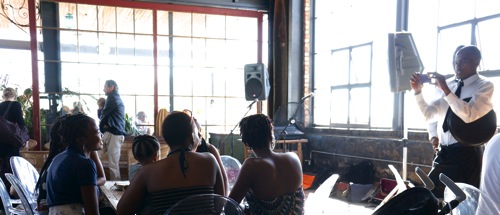
Upstairs reveals Katy's, a large open room filled with the good and beautiful of Sandton at lunch and Saturday drinks. Open to the skyline on one side and bordered by an upper level balcony on the other, wooden tables and elegant plastic chairs are spread round the large floor area. In one corner a two piece band noodles out average cover songs of REM and Coldplay, interspersed with original pieces of inspired fiddling and flute - until they are reduced to “It's a Beautiful World” and a terrible rendition of George Michael's “Faith” makes it time to leave.

130407 Kramerville 1680
The waiters are black - except for the white manager - but so is some of the very chic clientele, which makes me wonder if South Africa it isn't at that stage where it's down to economic status pure and simple, and talking about colour is really becoming a confusion, at least where places like the posh suburbs are concerned.

More photos from Kramerville at Flickr.


www.flickr.com

22 December 2009

Pictures from the road - Madaba

DSC00283.JPG

As everywhere else we have been, here truck drivers take inordinate amounts of pride in their vehicles. In this case decoration is in the form of extra bits welded and painted on to the body of the pick-ups.

DSC00377.JPG

Chickens keep fresh longer if you don’t wring their necks until after you find a buyer. These guys are kept in cages at the back of the butcher shop - although the rooster is allowed to strut around free.

DSC00385.JPG

A front porch to admire. Definitely the sign of a sociable family.

DSC00395.JPG  

Buffy gets around. We have also spotted a very young Brad Pitt, a smooth Alec Baldwin and a pouty Leonardo di Caprio. These shops sell a range of things, mostly fashion or hair cuts.

DSC00447.JPG

While Jordan is a predominantly Muslim country, Madaba has a bunch of (orthodox) churches, but I think the reason for this shop’s success is just that everyone likes a good excuse to decorate their house with glittery things.

06 December 2009

Views from the road - pedestrian edition

IMG_6167.jpg

The view from the roof terrace includes the herd of sheep living in the ruined plot below us.


DSC00146.JPG

Two kinds of people you can depend on for constant hassle as you walk down the street: The caleche driver who will take you anywhere for 5 pounds and the fellucca captain with a good price.


DSC00198.JPG

The souq is split between selling glittery things for tourists and useful stuff, like these huge foul bowls for the locals.


DSC04311.JPG

We are close to the beginning of the high season in Egypt and many cruise boats are anchored here to be refitted and cleaned up before they go back to Luxor for the winter rush.

DSC00005.JPG

More random specialisation of Egyptian shops. This one concentrates on blenders and sewing machines, presumably on the premise that it doesn’t matter why things whirr round, as long as they do.

28 November 2009

Here we are... what now?


DSC00108.JPG

Aswan: Lake Nasser, Abu Simbel, Kitchener’s Island, souqs, feluccas, temples, museums - the possibilities are endless. Most people who come to Aswan rush from sight to sight, aware that they only have a few days to see it all. They sit in a cafe drinking mint tea, for the experience. They stroll down the corniche, for the view. They drink in the sounds and smells of the city, because they are leaving far too soon.


DSC00128.JPG

We, on the other hand, are landed here. Of course we were going to spend a day or two, recovering from the Wadi Halfa ferry, taking a look at the temple of Philae, meet up with Alex. But basically this was our entry and moving-on point for Egypt. Instead, thanks to Eid al Adha (ironically a celebration of sacrifice), we are stuck here waiting for our car to catch up with us from Wadi Halfa. This gives us a whole different view on the town. Instead of an exciting holiday destination it has become a temporary home for our lost souls. Street vendors quit the banter and nod sagely when we tell them we are here for the duration, the hotel is promising a good room for the long-term tenants, and walking the streets we are more interested in the location of the cafe round the corner and the shop selling phone credit than the pretty view or the souvenir bargain.

DSC00114.JPG

Luckily the town has been quiet today, one advantage of the Eid holiday is the absence of cars and people. The few shops that are open cater to the tourists who have descended from the Nile cruise ships which throng the Corniche moorings belching diesel fumes. Other than the mzungus there are groups of rowdy boys on bikes and girls dressed up to the nines roaming the streets, trying out their meagre English on any foreign-looking passer by. We eat lunch, go for a walk, and back to the room to lose ourselves on the internet. Only ten more days...

01 November 2009

Shopping Part Three

Development aid is a big business, and this book together with the Yellow Pages for East African NGOs were available everywhere.
Adult reading schemes are big in Kenya, and these books don't tell kids stories.
In a country where only a few percent of the population has electricity, petroleum lamps and spares are essential shopping.
It is hard to imagine that the target market for pet grooming products has great overlap with that for farm animal feed, but by the spread of cattle herds and other assorted live stock in the city I guess that's a faulty assumption in Nairobi.
I like the way that the incense suppliers of Kenya are so non-denominational.
The cliché has finally arrived in the shops, would Karen Blixen approve?

28 August 2009

Shopping Part Two

Malawi has no cities to speak of, so all our supplies come from small towns along the road. The days of big Shoprites and Kwikspars are long over, Lusaka was the last place we managed to score luxuries such as sour cream and blue cheese. The villages along this road are busy, lively and real focal points. Lining the roads are lots of shops, but it's the sandy areas on front of the them that it all happens. Women spread their produce on small mats surrounded by wooden frameworks from which hand bundles of purple, blue and black plastic bags. I never imagined that I would be able to get so much fresh fruit along the roadside, from bananas to tomatoes, aubergines, avocados, onions, corn leeks, cabbages, pineapple apples, pears, potatoes and peanuts. Somehow I expected it to be hard to get fresh food, as I imagined the shops to only stock dry goods and non-perishables. On the one hand: a market in Mulanje, where women spread out their fresh produce from the handkerchief sized fields, red onions in bushels, little piles of red tomatoes, fresh and cooked corn in the husks, sacks of peanuts, big heaps of cabbages, leaves scattering everywhere, brown mounds of potatoes, symmetrical assemblies of avocados, pineapples and aubergines. As we pull over, all eyes turn to us. We get out to look at a lady selling tomatoes in small heaps from a mat, and when her English insufficient a local man steps in. Evas, scruffy but clean, helps us out by sending off small children to get any veggies we desire. All around us are gaggles of kids, nosy but shy, and everyone wants to get the chance to sell us something. I was afraid to offend by turning down all these offers of food, but the women who are rejected smile and move on to another customer. This is our first time at a local market, shopping out there rather than in the supermarket. We have deliberately held back in Lilongwe as the food along the road looks so good and fresh. We move on, looking for fresh corn for dinner, but accidentally end up with boiled, which actually makes it easier to prepare later. Maize is still a staple here, although there is so much exotic fruit and veg around that our diet is quite varied. Next we move on to roast peanuts, which are sold by girls and boys in small bags from bowls carried on their heads. After a fair amount of bargaining for all sorts of foods this is the first time we feel we are being charged foreigner's prices. A little girl tells us that the bag of peanuts costs 10 Kwecha, but her big brother chips in to tell us it's 20. Despite the big brother pressure she sells to us for 10 and tells him off for cheating. On the other hand, a People's Superette (local chain) in Selima, where we dropped in with a long list of needs after having camped for a few days and run out of most dairy and some other items:


17 July 2009

Shopping

We have been blessed so far with a supermarket in the most unlikely places, and so far we have managed to stock up at regular intervals. I am not sure that is always going to be the case, so I try to make sure that we have some of our favourite foods in store: vanilla tea bags, chilli sauce, olive oil. But it's already becoming clear that the urban necessities are going to be hard to come by. i have been looking for parmesan cheese ever since we left, so I could make lemon pasta, but no luck. Sour cream for chili wraps, no dice. But hey, we're flexible, so we are big on corn fritters at the moment, and we convinced Stuart to try some butternut squash, which is all the rage in the remote fuel/shop places.

For many people, when we told them we were going to travel across Africa, the big thing was: where are you going to put all the food, as you won't be able to shop along the way? We of course have no idea what it's going to be like, and we have not really left the very civilised and inhabited places of Southern Africa yet, but we are hoping that wherever there are people we will be able to get food, of some description. The trick is to be inventive with the menu, kind of like ready-steady-cook with potentially mysterious ingredients.

16 July 2009

Only 1 Euro!

We've been eating these for more than a week now, today finished the last one. Bought for 10 Rand at the side of the road somewhere north of Cape Town. It was like having a never-ending bag of vitamin C. They were so yummy, we are going to get more as soon as.

16 June 2009

This is driving me crazy!

There are many little inconveniences when one moves countries a lot, but none seem so deliberately infuriating and purposely designed to force me to tie myself in knots while trying to do something simple than DVD region coding. Man, as if it wasn't enough that I have to rip or re-buy my films if I want to watch them on my iPod, but to stop me from watching stuff on my computer just because I buy DVDs in a variety of countries that have been randomly assigned to different regions, that is just too stupid.

Of course my Mac should have a region free drive, and of course I could just wait to buy DVDs until I am back in Europe, or I could pay for a download from iTunes and then deal with the DRM on that and pay extra for the bandwidth to get the film that isn't all that much cheaper than a DVD in the first place and includes no extras, but why? How did we get to a place where I am a criminal for wanting to watch a movie? Soviet Russia much?

Grrr.

Just to give you an idea how totally ridiculous these regions are, here is a map. South Africa with Europe, why? And Australia with NZ and South America, good idea! At least Leo doesn't have this problem (as long as he stays out of the US).

01 April 2009

What I love about Germany. Part 1

Mineral water in crates. You return them to a machine that counts how many bottles you have and gives you your deposit back. All sorts of recycling including batteries. There are collection boxes in the shops next to the rack of new batteries. Brilliant. Train stations and airports have bins where you can separate paper, plastic and cans.

18 March 2009

The South African Satwa


Who says that all Joburg shopping is either Sandton City or street hawkers? At the suggestion of Dixon, who knows all the best places to go Anna and I made our way to Oriental Plaza and discovered the best mall in town. You can really get anything there, from fabric to curtains, dresses and suits, fake flowers and rattan baskets, spices and samosas freshly made. Plus lots of interesting conversation with the shop keepers, a mosque and benches to sit and watch. Truly we have found a place as interesting and fun as Deira, Satwa and Karama rolled into one.

18 February 2009

Dubai bashing

I haven't lived in Dubai for years now, but left with great difficulty and judging by my continuing interest in Dubai news I guess I still love the place. There is much Dubai bashing going on lately, fuelled by this article in the New York Times, it seems. While some of the facts are disputed already (apparently the figure of 3000 cars abandoned at Dubai airport is misrepresented and the number of cancelled visas is not offset by the number of new visas granted) it is most interesting to me to find this tone of Schadenfreude levelled at a Middle Eastern success story. As if it was somehow just that one of the few Arab economic successes should fail. Do we prefer the alternatives of repressive financial basket cases such as Egypt and Pakistan? This article is another rant at the perceived shallowness of Dubai and it's inherent unsustainability, entertaining even if I disagree, but with the best commenting I have ever read in a blog, ever.

27 January 2009

About time

With a ruler who is a warrior (he used to be minister of defence) and also a poet, this was only a matter of time. Behold, the Dubai Poetry Festival.

My favourite comment:

"shopping malls in Dubai will witness unprecedented ancient poetical activity that used to take place in the old times among Arab," he said, adding, "people used to gather and exchange, talk and challenge each others, using the language of poetry, and such phenomenon will be resurrected in Dubai, during the poetry festival."

05 December 2008

The Essentials

I guess I have found my local supermarket. It's essential, obviously, once we get over eating out, but often surprisingly hard to find. While there are plenty of multinational chains (Carrefour in Dubai, Spar in Johannesburg) it sometimes takes a few attempts to find the place with the right food at the right price. Surprisingly here it turns out to be Woolworth. They may be going bust in the UK, but here they are the local equivalent of Marks and Sparks fool hall. So far the other places I have tried are either too far to walk or have a crummy fruit selection. How is it that a country with almost permanent summer can't produce nice peaches or decent banana?. I blame it on the global food crisis. Anyway, Woolworth it is for now.

12 November 2008

My new toy

I photograph a lot. I also draw sometimes in my diary where I also keep pictures, clippings and interesting bits of paper. So far I have not found a good way to combine the photography into my diary. Digital helps, since I can print out photos myself instead of waiting to get print back from the shop (how quaint that seems now). But usually I forget or don't get round to printing photos for ages, and them I can't find the glue, and the writing in my diary has moved on... Anyway, a minor pain, but annoying to my completionist creative tendencies. A few weeks ago I remembered that you can find anything on Google. Now I am the proud owner of a Polaroid Pogo. It's a tiny battery powered printer that makes 3x5 inch sticky photos without the need for ink cartridges. How cool is that! My life is minimally better now. Is that sad?

13 October 2008

Shopping in foreign climes

It seems so simple. Go food shopping for two people who eat out a lot: some juice, crisps, some cheese and crackers, fruit, milk and teabags. A doddle. But. You have no transport. And not only don't you know where the nearest supermarket is, but you don't know what it's called, and when you find out the names of the shops you don't know where you get the freshest fruit and what teabags are strong enough and if it's ok to take the trolley out of the shop with you. And then you try to find your way back to the car park in an unfamiliar shopping mall that somehow reminds you of Dubai with the glitzy shops and the designer clothes, but despite checking the map constantly - I can't believe I need a map to get around the shops - you still walk past the same carpet shop three time. And I haven't even started on trying to figure out a currency that has multiple versions of each coin...
I can't wait till I get round to working out how to buy my (pre-paid) electricity and get the broadband set up. I'll let you know how that works out.
Mobile Blogging from here.

Am I Back In Dubai?

07 October 2008

Nelson, larger than life


Our first trip to a shopping mall last night, and who should be there but old Madiba himself. The square of course is called Nelson Mandela Square, what else. Just as well we went to buy some books on South African history

06 October 2005

Revealed at Last: Karama's Real Fakes!

Shopping for real fake designer goods is a popular pastime for visitors and residents alike. You can get Gucci bags, RayBan sunglasses, Von Dutch t-shirts and Rado watches, all at prices closer to Woolworth than Rodeo Drive.

These sales are done extremely surreptitiously, as the local authorities frown upon counterfeit stuff, and there are frequent raids. Usually we are asked if we are interested in buying watches or bags, and then are shunted into the back of a shop, into a small room upstairs or a cubby hole hidden behind some convincing looking shelving. In this case we were in a tiny shop in the middle of Karama shopping centre, where the proprietor conjured watches from the most unlikely hiding places: fake drawers in display cabinets, innocent looking bags hung up along the walls for sale, at one point he even pulled them from inside a tissue box.

IMG_5503-2005-10-6-10-46.jpg

Usually we are not allowed to take any photos, for obvious reasons, but at one point all the shop keepers had gone off to find more watches to satisfy Naime's discerning taste, and I was able to take a shot.

03 December 2004

God and Mammon

Today's trip took us from spirituality to consumerism, from Jumeirah Mosque to Bob's Antique Museum.

Unlike many places of the Muslim world, where mosques are open to the non-muslim public, there is only one mosque in Dubai which can be visited. The Sheik Mohammed Centre for Cultural Understanding has arranged a tour through the mosque's interior with a question and answer session on the subject of Islam. To our surprise a whole crowd had gathered in front of the mosque at 10 am this morning, rather than the few interested souls we had expected. We took off our shoes and the women donned their head scarves, then we were led into the mosque.

The space is simple and square, with few of the complex symbolic spaces of a church. There is a central carpeted area for prayer, a niche at the front, facing Mecca, for the imam, and a separate ladies' prayer room off to one side. Otherwise notable are some reading areas and the signs that show the next day's prayer times.

A volunteer from the centre explained the significance of the architecture to us and then went on to enlighten us on the basic ideas of the Muslim faith, the five pillars of Islam. We talked about the role of women, cultural differences between different Muslim cultures of the World, and the practicalities of prayer. V. interesting.

IMG_4375-2004-12-3-10-46.jpg

Inside Jumeirah Mosque

After a refreshment break we moved on to a haven of commerce by the name of Bob's, or the Antique Museum. Both of these names do no justice to this vast warehouse of tack, souvenirs and just general stuff. First of all it is impossible to find on a first visit, as it's in the back of an industrial estate in deepest Al Quoz, near the cement factory, the last place one would imagine shopping for curios. The entrance is in an alleyway, next to a mini-mosque, down a dusty road. But through it's humble portal one enters a huge space of rows and rows of shelves groaning with Indian, Arab, African items, from sculptures to vases, t-shirts to jewellery, pashminas to clocks, Christmas decorations and lamps and fluffy toys, picture frames, sheesha, wooden boxes, curtains, bellydancing costumes...

We shopped till we dropped.

IMG_4398-2004-12-3-10-46.jpg

Bob's Antique Museum