
At one point it seemed as if we would never leave Kenya, as if we would bounce back and forth from Jungle Junction campsite in Nairobi in ever decreasing circles, attached by a rubber band to the little bit of easy living we could find in East Africa.
We arrived from Tanzania on a car repair mission, then, suspension repaired and with an improved double suspension, we headed out to Maasai Mara and on to Uganda. We returned to Nairobi to meet up with Mark and Martina (and to say goodbye to Merryl, who left us for the other side of the World), left again for a short visit to Lake Elementaita north of Nairobi. Then we returned again on our way through to the South, for a lost week at the beach, diving and dozing. Returning for the last time to Jungle Junction we finally got ourselves ready to move on to Ethiopia (which was not without its hiccups) but we finally got out of Kenya, despite all signs to the contrary.
Why was it that we drifted round this country for such a long time? We stayed here longer than anywhere else, criss crossed the country in an aimless pattern, spent the a whole week in one place, the longest time on the trip so far, and returned to some places multiple times, something we hadn't done anywhere else. Was it that we were glad to be somewhere we liked, as opposed to the unpleasantness of Tanzania? Did we lose our way halfway through the trip? Was Kenya just so fascinating that we couldn't leave?

What is certain is that Kenya turned out to be an eye opener. One of the better regarded, more well-off, more stable countries in Sub-Saharan Africa, it is a place that wears its problems on its sleeve. Kenya has a terrible infrastructure: In Nairobi most houses, if they have electricity at all, only get switched on every other day. Big cities like Kisumu, Mombasa, Nakuru have the worst roads we have seen in any country. Everywhere we went there were signs of the current drought, from starving cattle to grey and dusty game parks, and not all of it can be put down to it being an El Nino year. Deforestation is turning hillsides into scrubby deserts that fail to support the subsistence farmers scrabbling to make a living there, and government support in the form of road maintenance and power or water supply is non-existent. The most exclusive neighbourhoods and most expensive tourist lodges in the most expensive game parks we have come across in East Africa are in Kenya, so ready cash can't be the problem. Kenya is the first place where recent history is still palpable to the casual visitor, and it's depressing to think how far a small place like Malawi might have to go when even a relatively well-positioned country like Kenya can't get its act together. It didn't help that I was reading a book about Kenyan corruption scandals (It’s Our Turn to Eat by Michaela Wrong), which put much of these problems into a political context.
Then again, the preconceptions we had about Kenya, where Nairobi is called Nairobbery and we were urged to lock up absolutely everything in and on the car lest it was ripped off, turned out not to be applicable to us. We even left our car parked outside a hotel in Nakuru overnight (nervously, and only because of a lack of off-street parking) without having so much as a fingerprint in the deep dust covering the door handles in the morning. Coming from Tanzania we found Kenyans to be more restrained and friendly, taking no for an answer even in very touristy places, although we were still very aware of being quoted mzungu prices. Bargaining hasn't stopped, it's just that our counterparty has been a lot more amenable to reason.

Kenya is potholed roads and nonexistent signage, suicidal matatus (what counts for public transport here, broken down mini busses painted with hopeful slogans and apparently totally unaware of road rules) and crawl-slow lorries; it's a street that suddenly disappears in the middle of Nairobi, leaving nothing but deep holes and mud and oncoming mini busses in a typically unlit part of town; it's witnessing two serious accidents and two obviously drunk drivers in the space of one night time trip - and being involved in our own little accident, taking four hours to extricate ourselves from the financial fallout of replacing a scratched door on a Nissan (not so) Hardbody; it was visiting the mythical beauty of the Masaai Mara only to find that the Masaai who are supposed to care for it don't and the rangers seem to care only for the tips from photographing tourists, in the process ruining the environment their livelihoods depend on, and it was left to us to restrain our guide from harassing the wild animals; it was the sorry sight of a parched savannah and deforested mountains, and wondering where all the money goes when a visit to a game park can cost US$250 per day.

Kenya was Nairobi, which saved our sanity, civilisation at last, when we were desperate for a bit of familiarity (although Marabou storks glaring from the lamp posts and slums next to posh malls kept the affinity in check): we relished in breakfast at Java Junction, dinner at a proper Italian restaurant with proper service, supermarkets selling prosciutto and parmigiano and a real Land Rover repair shop, a national museum that hadn't been thrown together in a day, some thoughtful historical and art projects and the sense of it being a real cultural centre.

Then there were the cool people we met: Joseph the Cambridge-educated ornithologist Masaai, obsessed with birds, who had met David Attenborough and Angelina Jolie (not at the same time), had cool stories of colonial life in Happy Valley and who revised my accumulated resentment of 'guides' who often have been more clueless than we are about their 'area of expertise'; Kiwi and the Mango Man and the other guys on Tiwi Beach who kept us in fresh fish and prawns and fruit and cashew nuts and without whom we would not have eaten so well without having to actually get out of the hammock; Christoph from Jungle Junction, about whom I have raved once already, and who is doing a much better job than I even know in keeping overlanders on the road North or South, and who does all this amongst the craziness that is Nairobi and Kenyan bureaucracy and a raving community of colour-conscious website crazies; Mildred the ape researcher in Kakamega, we had too little time to find out everything she knows about blue and Colobus monkeys, although we realised it must be much when she can recognise them by name in the dusk at a distance of twenty meters; and lastly (but only because we met them on our last days, on the way out of Kenya) there were Peter and Rita the Dutch couple running Gadissa Lodge and a centre for disabled children in the Wild West of Isiolo, Swiss Henry who provided us with two new roof rack brackets and a cottage as a pit stop on the dreaded Marsabit road, and Mr Mangia, who sold us a deep cycle battery when we least expected it.

I have not mentioned the diving on an incredible reef in the Indian Ocean, the wildebeest we watched crossing the Mara river in the face of crocodile attacks, the romantic plains around Lake Elementaita where I finally understood how one can fall for Africa despite all the craziness, the total paradiseness of palm trees on a white sandy beach, the forgotten beauty of North East Kenya where the remote desert belongs to the Samburu and the cattle rustlers and that might be the only way it will stay as untouched as it is right now. I haven't mentioned them because the pictures will describe them better than I ever could.


 Stuart's Favourite Location, out in the Nowhere
So we packed the cars with food for a week, spare fuel and two jerrycans of water, sleeping bags and tents. We set off about lunchtime at a slow relaxed pace on the way to Abu Dhabi, then turned left and headed inland on a road as straight as if drawn with a ruler. 100 km further we hit Liwa oasis, a crescent-shaped line of ragged houses lining the road in between vast fields of vegetables and alfalfa.
 Liwa Road, Plantations on Either Side
We struck out into the dunes, as big as we've ever seen, only to get stuck 200 yards of the road. When we couldn't get out after an hour of pushing and shoving, using sand ladders, our new inflatable jack and a lot of elbow grease, we gave up and camped in the lee of a dune.

 Definitely Stuck ... But Still Enjoying the View
The next morning we went for help with the Range Rover, which wasn't stuck, and found some rope and a man with a rickety Landcruiser van who kindly helped us to get out. After that we were more careful. Obviously the combination of softer sand and a heavier car (more people and gear) meant we could not be quite as gung-ho as we normally are.
 Mark's First Desert Birthday
We spent a few extremely quiet and peaceful days roaming the Liwa dunes, and then wanted to move on to Al Ain via the inland route, but were turned back at the halfway point by a fence and some intractable UAE border guards. The area is sensitive for various reasons, it being the location for oil drilling as well as a badly maintained border to Saudi. We had to make do with the long way round via Abu Dhabi and the coast road.
At Al Ain we visited Jebel Hafeet again, mostly to make use of the pool after four days of washing with a thin jet of water from the pump. What bliss to jump into endless gallons of it!
 Martina is relishing the fact that there is water EVERYWHERE!
We continued on explore some of the campsites in the Al Ain area we hadn't got to before, found a beautiful waterfall and a great remote plateau overlooking the Hatta mountains, but were severely disappointed by the amount of rubbish left by previous visitors and blown in on the wind. It's an ongoing problem here, there is a general disregard for the natural environment and many people just leave their crap behind regardless of the mess they've created. We have taken to always carry rubbish bags to at least collect and dispose of what we can even if we didn't bring it.

 The View across Hatta and the Waterfall
We spent the last night at our favourite spot near Hatta in a wadi far off the main track. There are pools there and at night it's quiet with endless stars.
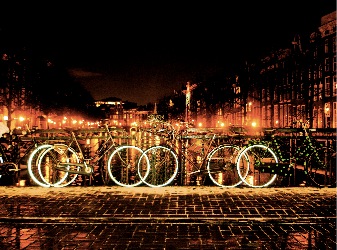 It's freezing, but still everyone gets on their bike
When we get ready to go to the airport to pick Stuart up from his 8.30 pm flight we find out that there is a delay, Copenhagen is snowed in. The flight will go that day, but no-one seems to know when. There are de-icing problems, runway problems, just general too-much-snow-and-ice problems. We decide to wait. Matthias goes to sleep in the car and Luca is a trooper and sleeps in the play area next to beeping, whirring, flashing playground rides.
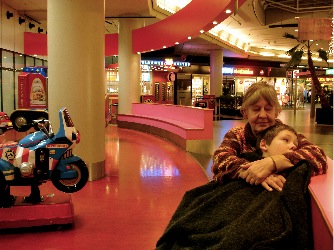 Tired, but undeterred
Eventually, at midnight, the plane arrives. We get home at 3 am, after another snow flurry on the Dutch plains. The lesson? Don't expect easy travel in Northern Europe at the end of December.