Showing posts with label Photowalking. Show all posts

12 May 2013

Jozi walking part 5 - Worldwide Instawalk

This is part 5 in a series on walking tours of Johannesburg. While other cities also offer guided tours, Jozi is unique in my mind as a place where people will group together, with or without a guide, to visit places that they normally wouldn't. Whether for safety in numbers, unfamiliarity or companionship, it's a thing here.

130407 Instawalk 1717
Instawalkers on the move
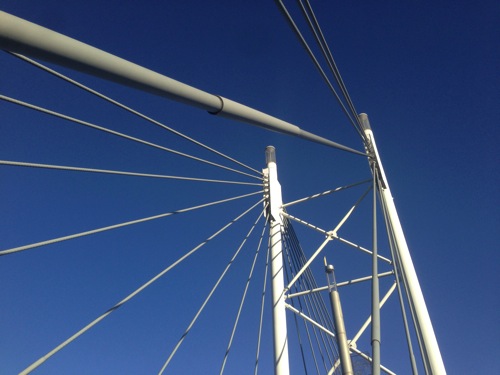
Today's worldwide Instawalk meets in Braamfontein. Its a special walk. Only my second, after the Fordsburg amble a few weeks ago, this one is very different. Part of the Worldwide Instawalk instigated by Instagram, it has  attracted photographers all the way from Pretoria. We even have a film crew to shoot a short film of the walk. I am happy to tag along, as I have wanted to shoot Nelson Mandela bridge at night, as well as the harder to reach parts of Newtown.
130407 Instawalk 1698
Nelson Mandela bridge
Last time it was only the four of us: me, Heather, Roy and Allessio from Pretoria. Today there are twenty people. I am finally meeting Uncle Scrooch and Gareth Pon, two of the movers and shakers of the Jozi Instagram scene. This is the first time my digital life spills into real life. I have never met most of these people, but because I follow their photo stream I know quite a bit about their lives.
130407 Instawalk 681
Almost gone
The crowd is homogenous: kids, hipsters, young couples. Mostly boys. I am the oldest person there by far. There is some delay as we wait for everyone to show up, and for the crew to set up their cameras.
130407 Instawalk 659
Daytime
When everyone is finally assembled, we walk across Nelson Mandela bridge in the late afternoon light. It's slow going, what with shooting the railway lines below us and the skyline on the opposite side. There is an element of wanting to get the best angle, the most interesting variation on a view, to 'see' a shot that no-one else has noticed. It's a competition of sorts. After a while everyone spreads out, looking for their own points of interest. When there is a good and easy shot, people cluster, but it's easy to get away. It's fun to look for the undiscovered scene.
130407 Instawalk 1733
Getting water from the street mains
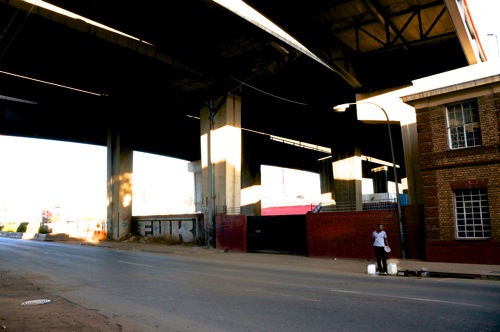
We walk down the ramp  into Newtown, past a building site with a lost house, an old villa teetering on the edge of the abyss that will one day be a mall. Cranes loom overhead. The motorway overpass edges the site, cars racing invisibly past. A little further a row of half-demolishd houses, a group of young men siphoning water off a broken mains, then we are in the warehouses of Newtown. A regeneration project of old factories, the area is now home to clubs and graffiti. In honour of the occasion we take a few group shots. Everyone is equipped with holi powder, and, positioned in front of a painted wall, we all jump. In between takes we all go back to shooting the small and the big, the unusual angle, the detail of the place. 
130407 Instawalk 705
getting ready for the jump
We return to Braamfontein via the bridge, catching the last of the great sunset light. Another photographer has the same idea, a fashion shoot is taking place across from us. A gaggle of girls and guys in skimpy outfits line up on the footpath, touching up make up and waiting their turn. It's a cheap and effective venue, with the colourful uplighters standing in for studio lighting and an unbeatable backdrop of the Jozi CBD. 
130407 Instawalk 1782
Night time
There is a video made by Gareth and Micklas on Vimeo:

More photos can be found in my Flickrstream:
You can find an overview of Jozi walks here, my account of a guided walk in Melville here, a Yeoville walk here, another account of instawalking here and my story of photowalking here.

28 April 2013

Jozi walking part 4 - Joburg Places and Spaces

This is part 4 in a series on walking tours of Johannesburg. While other cities also offer guided tours, Jozi is unique in my mind as a place where people will group together, with or without a guide, to visit places that they normally wouldn't. Whether for safety in numbers, unfamiliarity or companionship, it's a thing here.

130406 CBD walk 105
Gerald, our tour leader, making a point
I met Gerald through my friend Heather. He is the author of the definitive Jozi guide - Joburg Places and Spaces 2.0. At long last I get to take part in one of his walking tours around the regenerated CBD. We meet in the current flavour of the month suburb of Braamfontein with its Neighbourgoods Market and the Lomo Gallery as well as an upmarket bike shop. It has everything a city borough needs to attract the better-off hip crowds of Joburg thirsty for new weekend venues: student bars, start-ups and refurbished condos.

130406 CBD walk 11
Neighbourgoods Market in Braamfontein
Grabbing some delicious biltong from the market we set for our six hour walk to see the CBD regeneration. Yes, six hours, but as Gerald points out, there are lots of opportunities to sit and listen to his story, or to gaze at the view, or to have a rest on the bus between destinations. The tour is offered most weekends, together with another walk from Newtown to Maboneng.

130406 CBD walk 19
Gerald explaining the layout of the CBD
Our tour today comprises of a German family whose son lives locally, a Portuguese couple of photographers - he lugs a tripod and heavy camera from shot to shot - and two older Jozi couples giving wistful insights into the history of their home town.
130406 CBD walk 46
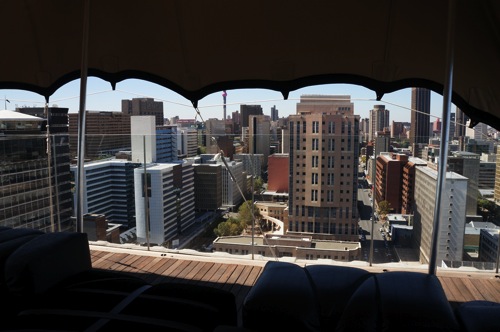
The view from Randlords
Before we set off Gerald gives us an introduction to Braamfontein, the CBD and general Joburg history. With the historical Kitchener's Hotel pub behind us and the freshly renovated Play Braamfontein store fronts in front of us, Gerald takes us through his theory of cities as microcosms of a country. The struggle for political power, for economic improvement, for cultural dominance, all this is played out all over South Africa, and in a concentrated form, in Joburg.

The view from the ladies - no, really!

We walk down the street to Randlords, one of the many private rooftop bars dotted around the city. The 22nd floor is one great window to the skyline, currently being set up for a wedding of hundreds. There is an elaborate deck with cushioned beds for lounging behind a glass bannister. There is even a swing for the playful-minded. The views south across the railway lines towards Newtown, east over the green suburbs to Brixton tower and the slag heap remnants of the gold mines, west to Hillbrow and the CBD are stunning, giving us a taste of what's to come.

130406 CBD walk 177
In the midst of the city
We meander our way through Braamfontein to the Rea Vaya bus stop at Park Station at the western end of Braamfontein for our drive to First National Bank in the heart of the city. The Rea Vaya, together with the Gautrain, are Joburg's latest addition to its frankly pathetic public transport system. This is a driving city, and if you can't afford a car, you are reduced to taking the crazy minibuses. They are dangerously driven, overcrowded and feel themselves above traffic rules, but they are cheap and run back and forth to Soweto. The Rea Vaya buses on the other hand have the potential to transform the public transport scene. They run on routes currently serviced by mini taxis, which made them controversial to set up (the mini taxi racket is highly profitable and tightly controlled by private bosses, which led to violent demonstrations, strikes and threats when the bus system was first implemented), but in its own pragmatic fashion the bus company has contracted the routes out to the former mini taxi owners, and employs the taxi drivers as bus drivers. There are still some problems, resulting in shiny new stations being boarded up while contracting disputes are resolved, but in the city at least the buses are running more or less on a schedule.

130406 CBD walk 141
Street trader selling peanuts and underpants
The bus arrives as soon as we get to the station, a cool sleek glass container with ticket barriers at either end. A sign tells us of all the activities that are not allowed at the station: no eating, no hawking, no waiting, no littering, no graffiti, no flyposting, no music, no smoking, no skate boarding, no guns, no dogs. One symbol of a hand is mystifying: No smacking? No waving? No gloves?

All the activities that are not allowed on the Rea Vaya


There is a smart card system in development, but for now we get paper tickets. The clean, new, fast bus (it runs in dedicated lanes through the CBDs grid) takes us downtown to the first of the regenerated areas. The Kerk Street development used to be a rough informal market street, but now has French-style open roofs for the traders and hair braiders stretched along the centre of the pedestrianised street. Both sides are lined with mainstream shops selling fashion like any other shopping street.

130406 CBD walk 116
Braiding supply shops
We stop at the bottom of the street next to a row of fruit and veg stalls to listen to Gerald explain the concept of public area regeneration. The premise is that since the council can't afford to renovate the whole CBD, it would improve the public areas to encourage private capital to come in and take over the run-down buildings. So far the city council has made good on the promise of making the streets of the CBD safer and more pleasant, and slowly businesses are moving back and transforming the dilapidated office blocks, many of which have previously been squatted. It's a huge struggle against the inertia of decay. Despite the new paving, the numerous pieces of street art, the pragmatic accommodation of informal traders, there are still plenty of potholes and broken kerbs. I see some of the grand old city buildings have been rescued or replaced with marble shininess, but there are still plenty of ruins with smoke-blackened window holes, graffiti-covered walls and boarded-up shop doorways. It's a long and slow process. 

130406 CBD walk 128
Hair braiders on Kerk Street
We proceed up Eloff street, once the fashionable shopping mall of the CBD with the most expensive properties, now slowly recovering. The new buildings of First National Bank nearby are bringing flush shoppers back into town. The kerbside is clogged with street stalls selling underpants and socks, bags of sweets and phone credit, cheap jewellery and pens. Women sit on wobbly stools having their hair braided.

130406 CBD walk 137
Markham's Department Store
We hear about the Markham building, an elaborate wrought-iron clock tower topping the oldest department store in the city, about the CNA headquarter, a once stylish five-storey corner block now boarded up and abandoned. We stop at the famous Rissick street post office, built by Paul Kruger to show the British that an Afrikaaner government could be as sophisticated as the Empire. Now a burnt-out shell after a 2009 fire, it was going to be demolished until a campaign to save the historic building forced a rebuilding project. At catty corners sits the grandly white Mutual Insurance building. Equally significant for its Edwardian building style, it, too, was going to be demolished, and will now be renovated and improved.

130406 CBD walk 167
Rissick Street Post Office
This is something of a theme: there seems to be absolutely no sense of architectural heritage here. Amazing historical buildings are simply abandoned until squatters make short work of the structure, and then pulled down to leave an empty lot that can only hope to survive as a parking lot, or have an anonymous glass and granite edifice parked on it. The CBD is filled with ugly sky scrapers from the bad old days of apartheid, the fatally style-deaf 70s have left their legacy, but there are also still some elegant Art Deco affairs, some late Victorian and Edwardian edifices of the Empire age, and some stylish 60s modernist blocks. No-one seems to think it important to preserve them.

Another intriguing architectural style, representative of 60s Apartheid paranoia
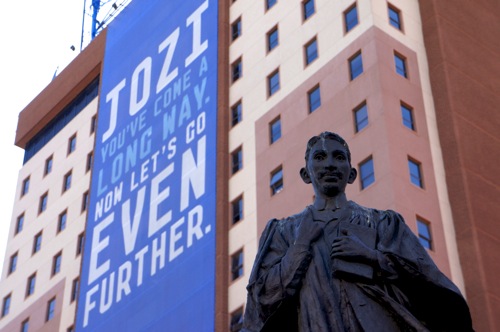
We have arrived in Gandhi Square, a large open space of bus ranks lined by lawyer's offices - the courts are nearby. Behind the bronze statue of the young Gandhi flutters a banner from the current council proclaiming:
 'Jozi, you've come a long way. Now let's go even further.'
130406 CBD walk 186
Gandhi would approve
Much of the regeneration of this historic square has come for the unlikely direction of a law firm (Olitzki) that took over many buildings in 1989 and has been involved in preserving both Gandhi's- he practiced law here before going to India to overthrow the British colonialists - and Mandela's offices - who also practiced law here before his arrest and imprisonment.

The regenerated Ernest Oppenheimer Park
Our walk ends at the Reef hotel, with the funky and cool Gold Reef Cafe on the ground floor. We take in one more sweeping view of the city, this time from an opposite vantage point of the earlier Randlords' view. Gerald takes us through the recent history of the city, explaining the seemingly sudden abandonment of the centre for the suburbs - and the new centre of Sandton. There was an element of self-destruction involved in the legal restrictions imposed by the Apartheid government to control the movements of the black majority. Laws to limit how many black workers an industrial businesses could employ if they had their factory in the city caused major problems. The number was six. With the introduction of the laws manufacturing businesses were forced to relocate. Large factories left the CBD, abandoning the southern area's industrial zone. Pass laws restricted blacks to homelands in rural areas, and only those  that had a job were allowed into the city. Since the factories were forced to move out, there was no access to the city for black workers or shoppers.

130406 CBD walk 193
Chilling on the rooftops
Then, in 1985, president Botha made a famously shocking speech called 'crossing the rubicon': in the face of international pressure instead of liberalising he clamped down on the anti-apartheid movement, made South Africa a military state, and declared a state of emergency. In expectation of the coming sanctions all international businesses left the city, leaving empty offices and ruined support businesses behind. At the same time the city workers left the northern city suburbs of Hillbrow and Yeoville, then bustling middle-class neighbourhoods, following the direction their workplaces had taken. Vast numbers of flats were unoccupied. Landlords keen to keep their income allowed flats to be occupied by poorer tenants, who turned to overcrowding to finance their new homes. The local municipality turned a blind eye because it disagreed with apartheid, allowing the deterioration of properties. In a few short years at the end of the 80s Jozi CBD turned from world metropolis into ravaged slum.

130406 CBD walk 112
A fashion afficionado in Kerk Street
We leave Gerald's tour here to return to Braamfontein, exhausted and enlightened in equal parts by this half day wander through the city. He will take the rest of the group on south and then return to Braamfontein by bus. I am left with a head buzzing with all the new impressions. It seems that every time I brave the CBD I see a new and fascinating part of it. There is the student hipness of Braamfontein, the cultural hub of Newtown, the hip lifestyle centre of Maboneng, the unjustly neglected art gallery and Joubert park. Now I can add the intriguing shopping streets of Kerk and Eloff streets.

You can find more photos in my Flickrstream.
www.flickr.com
You can find an overview of Jozi walks here, my account of a guided walk in Melville here, a Yeoville walk here, an account of instawalking here and my story of photowalking here

11 April 2013

Jozi walking part 3 - Instawalking

This is part 3 in a series on walking tours of Johannesburg. While other cities also offer guided tours, Jozi is unique in my mind as a place where people will group together, with or without a guide, to visit places that they normally wouldn't. Whether for safety in numbers, unfamiliarity or companionship, it's a thing here.
IMG 7390
There's always one...
We met in Newtown in plenty of time to catch the sunset. Like a clandestine group of spies we gathered in a car park. Roy arrived on his scooter, Alessio drove in from Pretoria, Heather and I from down the road at Melville. It's my first Instawalk. Getting invited was a bit of an effort. True to the spy theme, you have to know someone who nows where and when the meeting takes place, and most important of all, that they even exist. There is no website, no Facebook group, to invitations. I feel like just for once I am in with the in-crowd.

IMG 7394
Afternoon in Fordsburg
The term Instawalking derives from Instagram, the fabulously popular photo-sharing site. Instagrammers are photographers of every kind, from selfie-shooting narcissists to baby-photo-posting parents, from collectors of urban moments to filter-abusing landscape artists. It's a cultural phenomenon, and since it relies on a smart phone camera, it means that snaps can be posted any time. Some Instagrammers have never used a camera before, some are professionals, most have developed a passion for shooting their life and times.

After a short conversation we decide to move on to Fordsburg to catch the sunset. The other three instagrammers are old hands, so I just tag along. They are looking for the right light, searching always for the un-noticed location, the unusual angle. The urban landscape lends itself to instagramming, so it is no wonder that the thing took off in Jozi, urban centre of gritty urban centres.

IMG 7391
The end of the day

Beyond the main street, in the warehousing Asian/Arab suburb of Fordsburg we hit the jackpot. Quiet streets, abandoned store houses, interesting afternoon shadows. As we wander the streets we are quizzed by onlookers. Security guards check us out, shop keepers take our photo as we take theirs, passers-by shake their heads at our interest in their run-down neighbourhood.

IMG 7392
Fully equipped instagrammers

Roy has come equipped. With his Ollyclip and his mini-tripod he flattens himself in the middle of the street, perches his camera on a high wall, changes lenses to grab just the right shot. The rest of us make do with the basic iPhone camera (although Instagram also exists for Android, today we are an exclusive iGroup), looking for the unseen behind the street frontages.
IMG 7387
Fordsburg public art
Fordsburg is full of unexpected sights: political graffiti on a garden wall, a mural high up above a row of shops, stylish art deco architecture, strange textures where paint has weathered and burnt. People are happy for us to photograph them: the woman on her way home with a baby strapped to her, the man carrying a big roll of fabric on his head, the shopkeeping brothers under their neon lights.

IMG 7383
winter is coming
Eventually the sun sets and we retire to Fordsburg market. A bustling centre for the neighbourhood, this Sunday evening it's heaving with families and friends out for an evening of window-shopping and dinner.

IMG 7386
Time for tea
The market is squashed into a tiny area between a main road and rows of shops selling glamorous but demure dresses, imaginative head scarf arrangements, shiny shoes and cheap electronics. It reminds me of Satwa, the Dubai neighbourhood most like a real place in that city of gloss and fake. We grab a cup of sugar cane juice freshly made and spiked with pomegranate, consider the many food options and plump for the Afghan chef in a white hat grilling chicken at his tiny stall. The nan bread comes straight out of the portable stone oven and the chicken is mouth-tinglingly spicy. A perfect end to a perfect walk. Let's just hope that I am invited back.

IMG 7393
hijab fashions
You can find an overview of Jozi walks here, my account of a guided walk in Melville here, a Yeoville walk here and my story of photowalking here. 

25 March 2013

Jozi Walking - Part 1

130209 Yeoville and Ponte 101
The other day someone asked me about walking tours in Jozi. Since I have attended a few and plan on taking more, and they are such a thing here, I thought I would write a series of posts about the different kind of walks you can take part in when you are in Jozi.

130310 Melville Walk 48
Discovering Melville's back alleys
I have to explain first to those non-Jozi people why visitors and locals don't just go for a walk, why they congregate in groups to explore a part of town. Most obvious there is the perceived danger of visiting some of the suburbs with less than salubrious reputations, like Hillbrow and Yeoville. With South Africa's turbulent history, it is not surprising that some areas of the city have at one point or another been no-go zones.

Then there is the strange suburban separation that means people are unfamiliar with other parts of town. Massive changes have taken place in this city since the end of Apartheid, making locals unfamiliar with their own home city. A hip neighbourhood might have become run-down, and businesses have fled parts of the city wholesale, and are just recently returning. It is disorienting and creates uncertainty.

And there is the usual reason for going on a walking tour: to get a knowledgable local guide who will illuminate a neighbourhood beyond the obvious.

130209 Yeoville and Ponte 33
Hillbrow Introduction
My friend Heather on her blog frequently writes about Jozi tours. It's a good place to start. My previous posts about walks are here and here. And as a first introduction, here are a few tour guides and organisations offering walking tours of one kind or another. Get walking!


More walking posts in the next few weeks.

19 February 2013

Ponte Inside-Out

130209YeovilleandPonte-51-2013-02-19-12-58.jpg
Ponte from afar

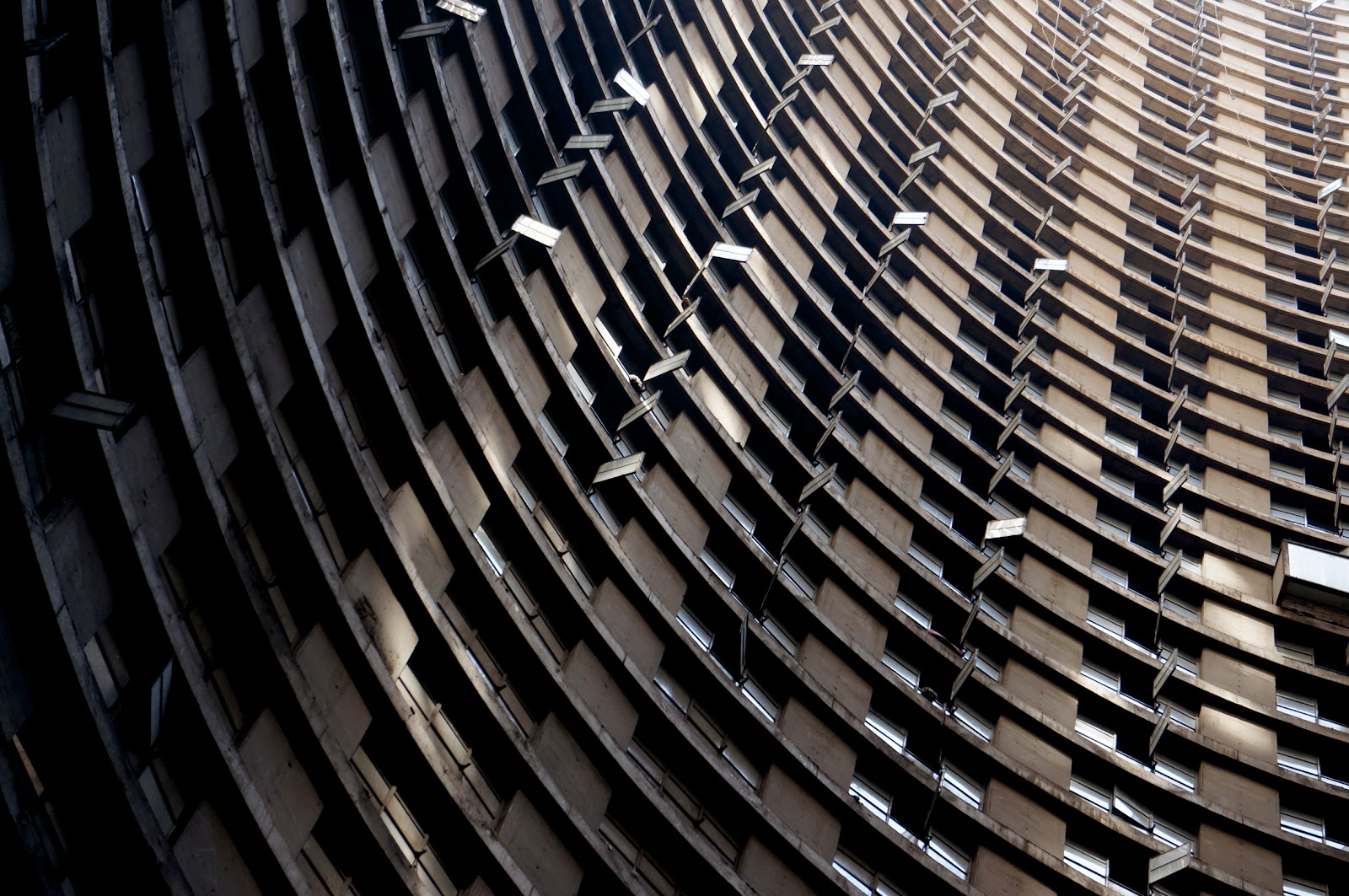
Last week I had the opportunity to visit the inside of Ponte City Apartments, one of Joburg's landmark building on the edge of Berea and Hillbrow. The Ponte tower stands high on a hill, a tubular masterpiece topped by a glowing magenta advert for Vodacom. Ponte was once voted second-most ugly building in Joburg. That seems unfair. Built by the 29 year old Rodney Grosskopff, Ponte has variously been called "a failed architectural attempt at avant-garde skyscraper living" and "a den of iniquity run by drug dealers and thugs".

That was during the sad days after the end of Apartheid, when whites left the CBD neighbourhoods and the area became a neglected dumping ground for immigrants and the poor. There was once a plan to turn it into a prison (as if it wasn't that already when the rubbish piled up inside the core to the 6th floor and whole storeys had been converted into brothels and shooting galleries).
130209YeovilleandPonte-206-2013-02-19-12-58.jpg
Inside the core, looking up at the hallway windows

At some stage there was a revival. The building was to be renovated from the ground up, with penthouse flats and flash furnishings. Plans for the unique, tubular core have included a climbing centre and a ski slope. There were financial wranglings, and then a recession, and it all fell apart. But, as if willing itself to be a symbol of the CBD's rebirth, there is now another, more sustainable initiative. The revamped ground floor with open spaces and clean shop floors will hopefully bring in paying visitors, a new biometric security system give a sense of safety, spanking new lifts replace the old creaky affairs.
I learnt all this only after my visit last week as part of the Yeoville walk. Now I am a little obsessed with the place.

130209YeovilleandPonte-196-2013-02-19-12-58.jpg
It's hard to stop looking up
Access to Ponte's core is actually open to all who dare. You just need to find the toilets in the shopping precinct and open the door to the internal stairs. We start by descending a decidedly skanky concrete staircase into the bowel of the hollow round interior of the skyscraper. While all the flats look out over the skyline of the CBD, the corridors give out to the inside of the tower. As we stand at ground level I am struck how the building clearly rises from the raw rock. It looks like a lava flow has solidified in the middle of the cavernous space. I first thought the fluid-looking slope was a torrent of composting refuse left from the previous state of disrepair, but then I realise it's designed like that. The image is of a human-built structure emerging from the bare rock as if extruded into existence.
130209YeovilleandPonte-193-2013-02-19-12-58.jpg
The building rising from bare rock

High up we can see clouds scudding past the circular blue cutout of the walls, but light barely reaches down here. The building partly sits on a two storey car park, a concrete grid letting in a little light from the side. We stumble across slippery slopes in the dimness, trying not to step into rubbish. Apparently the place is still abused as a quick disposal unit: egg shells, condoms, nappies, the usual. The space reminds me of the Gasometer in Oberhausen, a former gas tank repurposed into an art space. That space is lidded, and nowhere near as tall, but with the same feeling of infinity, of air and light bouncing off a circular space.
130209YeovilleandPonte-202-2013-02-19-12-58.jpg
A tiny glimpse of the sky from the base of the core

We ascend back to the ground floor to enter through the heavy security into the building proper. A serious looking guard behind a window, ID to show and a book to sign, a fingerprint scanner to operate the revolving gates - this place is as tight as Fort Knox. We ascend to a flat on the 52nd floor in one of the new lifts, padding covering the gleaming steel interior. Previously the flat was a two storey penthouse apartment - we can still see the stairs going nowhere next to his front door - but now it is a two-bedroom loft with a large open-spaced living room/kitchen. He is sharing with another person, bedroom off either side of the living room for privacy, and pays R5400 per month! The view, of course, is stunning. The windows open, giving a frisson of vertigo when I hold out my arm to take a photo. Fresh air wafts in with the view across the south of Jozi, a unique vantage point.
130209YeovilleandPonte-224-2013-02-19-12-58.jpg
The view from the 52nd floor

Much has been written about Ponte by people who are more knowledgable than I am about Jozi's recent history. It makes me think that the building, standing prominently on Jozi's skyline, is considered a cypher for something bigger, a hope of renewal, a marker in history. My obsession grows.
130209YeovilleandPonte-184-2013-02-19-12-58.jpg
A human being for size comparison
Update April 2012: I discovered a poetic little film about Ponte

Also, another article has the strange assertion that the design has flats for whites looking out and flats for black servants looking into the core of the building. As far as I could see all the flats had views to the outside, and the windows overlooking the inner core lined the corridors. Am I missing something?

09 February 2013

This day in history: Photowalks

Photowalker at the wishing tree
This is going to be a new series of post. Why? Because I have not blogged when things happened, so now I write about them in hindsight. That way I don't feel that I am so very very late with my writings, and I can still talk about the events I want to talk about... 

Cinema becomes church - suspension of disbelief continues
I can see that a year ago this month I went on my first and second photo walk. For those not in the know, the photowalkers are a Johannesburg group (do they exist anywhere else? I have never noticed them before, but who knows...) of amateur and pro photographers who walk the streets of Joburg and its surrounds in search of a good shot. The group has been going since 2009 and was founded by Mark Straw, who seems to have an indefatigable enthusiasm for devising new and interesting places to visit. 

Giving out New Year's good luck charms

Chinese New Year

My first event was the Chinese New Year celebrations in Bronkhorstspruit at the Nan Hua Temple. Heather, who first mentioned the whole photowalker concept to me, assured me that everyone would be friendly, and that she would introduce me. As it turned out we never even met any photo walkers, although they were surely there, because the temple was crowded with visitors.

All kinds of food for sale
The centre square of the temple was used for dragon puppetry, fireworks and general celebration, while the walkway around the square was crammed with stalls selling everything from massages to orchids, swords to dumplings. The temple itself was a quiet centre of the proceedings, where we could sit and take things in. 
Just outside the front entrance was a wishing tree festooned with ribbons where people left their wishes for the new year. Photo opportunities abounded. Even though we didn't meet the photo walkers, we came away with a haul of good pictures.

Art Deco Photowalk


The splendid Benoni Springs Fire Station (thanks, Anonymous)
It was on the next photowalk where I really got into the whole thing. Meeting in the morning at a mall in East Joburg, about twenty people divided up into cars for the ride out to Springs for the first part of an architectural tour of Joburg's satellite towns. 

Photowalker in action
A local architect showed us the art deco treasures of Springs: the town hall, local schools and private houses, and on the main street a cinema turned church as well as rows of shops and warehouses - all sporting fabulous Art Deco styling. 

Glorious Art Deco in Benoni
We ended up at a locally famous ice cream parlour where we got to go into the inner sanctum, where the delicious ice cream was made. The rest of the day was spent at Benoni where a splendidly designed fire station kept us occupied for quite a while. 

I spend a lot of time walking around cities (and the countryside) photographing what I see. I guess that makes me an urban photographer. The difference between going for a walk on my own and a photowalk is like night and day: In a group there is the challenge to catch that shot that no-one else did, find an angle that no-one else has. 

But it's not just competition. In a new place I am always fascinated when I see someone else take a picture. I creep up behind them and try to work out if they have discovered an interesting subject, what it is they are looking at. On a photowalk that is multiplied, because we all stand behind each other looking at the others' shots, wondering if we can capture something worthwhile, but different. It's a constant pushing and intensifying, scrutinising and questioning of the current view point. What else is there? How else can I capture this? What am I missing?

Want to go photowalking?

Blast from the past - analog photos
A Pentax K1000 in the wild
Photowalkers also use a wide range of cameras. There are the standard digital SLRs equipped with a range of lenses from fish eye to telephoto, but there is also the iPhone, the Helga, the old-school Pentax K-1000 with an external view finder. There is a refreshing lack of snobbishness around equipment, a mutual interest in each other's choices.

Best thing about photowalking? Going to places I either didn't know existed, or wouldn't have been brave enough to visit by myself. Joburg photowalkers are on Meetup, and as it turns out so are a bunch of other photowalking groups, so there is no excuse not to get involved.

More photos here: 

2012 Chinese New Year


www.flickr.com
fiverlocker's 2012 Chinese New Year photoset fiverlocker's 2012 Chinese New Year photoset

Art Deco Photowalk


www.flickr.com
fiverlocker's Art Deco Photowalk photoset fiverlocker's Art Deco Photowalk photoset