Showing posts with label culture. Show all posts

19 May 2013

Songs of Migration

A trip to the to the theatre. In Jozi it's my first time. While I visit the theatre in the UK frequently, I am not in step with the venues and schedules of shows here. My impression so far has been that there is the famous Market Theatre, fabled point of resistance against apartheid (but I have no idea what quality of shows they put on now) and a load of touring shows from Europe and the US, interspersed with Afrikaans comedies and bland Whitney Houston impersonators. It turns out I couldn't have been more wrong.

The Joburg Theatre is a big 70s building at the top of Braamfontein. I don't know what I had been expecting, but the space is massive, more South Bank than regional playhouse. A grand entrance hall with escalators, high ceilings, a cafe and lots of room for mingling outside the vast auditorium.
130228 Hugh Masekela 69
We had come to see Hugh Masekela's production of Songs of Migration, a story of the African experience, where men and women frequently travel long distances to find work, away from home for months and years.
The audience was overwhelmingly black, and raucous. Whether that's because there were local drama students in the cast, and the whole balcony seemed to be filled with friends and family, cheering every nifty turn and perfectly pitched note, or that the material generally invited calls and participation, I am not sure. It made for a lively atmosphere.
130228 Hugh Masekela 63
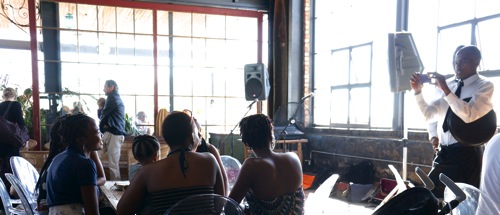
As soon as the performance started I realised that it would be even better than I expected. The cast of 20-odd was impressive, all singing with individual voices, dancing superbly, and performing without the over-acting that often happens with performers primarily trained as singers. The whole show was narrated by the indefatigable Hugh Masekela, dressed in a snazzy black and purple suit and a loud tie. He threw in amazing trumpet solos, all improvised. The guy is 74, but he performs and dances like a much younger guy. It was a joy to see him sing at the top of his voice, to boogie with the much younger women, to dance his peculiar style: he bends his knees low, almost kneeling, and walks with a groovy shuffle that Michael Jackson could have learned from.
130228 Hugh Masekela 70
The locally famous Gloria Bosman, a soul/opera diva with an interesting choice of boldly patterned dresses, is his partner on stage. They take turns narrating the lives of poor workers flocking from the country to the city in search of work in the mines (for men) and as housekeepers (for women), of the people left behind, and of the people travelling from faraway places to South Africa to improve their lot, to flee persecution and war.
130228 Hugh Masekela 73
For most of the first half I was quite lost, as most of the songs were in either Khosa, Zulu or Sesotho, so I was guessing the meaning of the story from the acting, and the occasional narration in English.Even the old Apartheid SA flag hoisted as a backdrop wasn't familiar to me. I just let the songs flood over me, enjoying the moment and slight dizziness of confusion. In the interval Moeketse and Corlette, my South African friends, explained the jokes that everyone laughed at, like the young man courting a girl while wiggling suggestively and it seemed involuntarily. Apparently there is a kind of herbal Viagra, which is popular and much joked about. 

05 May 2013

Hanging out with the elite of Kramerville

If you live in Joburg, you know of Sandton, the financial and shopping centre in the northern suburbs. It's very shiny, very white and very far away from the rest of the city. It's where all the banks and big business fled during the bad 80s and the mad 90s when the city centre turned in to a riot - literally - of protest, squatting and chaos. Sandton it's all shiny high rises and expensive bank lobbies congealing around the gleaming mall of Sandton City with its incongruous statue of Nelson Mandela wearing a Hawaiian shirt in the central square.

130407 Kramerville 1616
Trying on cool glasses
More on the weirdness of Sandton another time. Today the subject is Kramerville, a mini-destination just north of Sandton amongst the uber-leafy villas and secured compounds of the elite. My friend Heather is researching a book about Sandton, and after her initial trip dragged us out there to see how the other half lives. As most places in Jozi, it is a well-kept secret, a small proscribed area beyond which lie quiet streets of villas and other boring bits. Kramerville is actually a CID, a so-called 'city improvement district', which means that private money is brought in to carry out maintenance, security and communal improvements where the local council fails to do so. It means fences, rubbish-free streets and newly planted trees, but also fosters a closed-in exclusivity. A double-edged sword.

130407 Kramerville 1612

Our aim was to visit two locations in Kramerville, Three Desmond, an interior mall with a Sunday market, and Katy's, a newly-opened bar/cafe nearby. Three Desmond is a blob of furniture, interior design and ethnic shops. It is really a retail park, with warehouse-sized buildings, parking out front, security guards in uniform and high fences around each parcel of land. The clientele is super-posh, rich, expensive. Once a month there is a market at the main block, a vast terrace filled with traders selling everything from laser-cut earrings to hand-made leather bags, from trendy t-shirts to pottery knick-knacks. There is a bar for the grown-ups and a pottery wheel for kids. The shops in the main building exhibit cool and very expensive furniture, carpets and flooring.

130407 Kramerville 1619
Shop till you drop
The famous Mud studio has a big shop, selling its classic chandeliers made from recycled clay beads strung onto a wire framework. We saw them in London last year as part of the South Africa Olympics pavilion on the South Bank. Unlike most country pavilions for the Olympics the South Africans concentrated on community projects, development businesses, including Mud, which strives to empower its workers to become independent traders and set up in business rather than just working for them. The items on the shop here are quite cool: roughly handmade plates and bowls, mugs and pots, cast onto moulds and stamped in the back with the studio label and the individual maker: Daniel, Mketa, Doreen. I like the idea, but the items are crazy expensive. €18 for a dinner plate, €35 for a platter!

130407 Kramerville 633
A classic Mud chandelier
As we look around this trendy shopping orgy the place fills up with yummy mummies - and daddies, hipsters (there is a young guy flashing his analog Leica), stilletto-heeled Sandton babes, and wannabe outdoorsy guys. A neat-freak kid has been plonked by its mother on to the pottery wheel seat. The potter is showing her how to throw a bowl, but she is pulling faces, afraid to get red clay on her pink outfit. She can't be more than three. By the bannister, overlooking the valley of Sandton, two young black women sit on the deck, nibbling snacks and drinking champagne. Their legs delicately folded under them, they are trendy, skinny, at one with the crowd.

130407 Kramerville 1652

We visit the other place on Heather's list for lunch and drinks. Amatuli is a vast warehouse that has been turned into an ethnic furniture and deco shop. On two floors objects, photos and furniture from all corners of the undeveloped world are for sale. There are huge beaded arm chairs decorated with lions; silver Ethiopian coptic crosses mounted on wood blocks; black and white landscape photos framed in remnants of pressed steel ceilings; wooden Buddha heads, blown glass lampshades, stone carvings of fern leaves, bamboo bowls, filigree tin-cut head dresses… It's like the Pitt Rivers museum if everything there was for sale.

130407 Kramerville 1662

Upstairs reveals Katy's, a large open room filled with the good and beautiful of Sandton at lunch and Saturday drinks. Open to the skyline on one side and bordered by an upper level balcony on the other, wooden tables and elegant plastic chairs are spread round the large floor area. In one corner a two piece band noodles out average cover songs of REM and Coldplay, interspersed with original pieces of inspired fiddling and flute - until they are reduced to “It's a Beautiful World” and a terrible rendition of George Michael's “Faith” makes it time to leave.

130407 Kramerville 1680
The waiters are black - except for the white manager - but so is some of the very chic clientele, which makes me wonder if South Africa it isn't at that stage where it's down to economic status pure and simple, and talking about colour is really becoming a confusion, at least where places like the posh suburbs are concerned.

More photos from Kramerville at Flickr.


www.flickr.com

28 April 2013

Jozi walking part 4 - Joburg Places and Spaces

This is part 4 in a series on walking tours of Johannesburg. While other cities also offer guided tours, Jozi is unique in my mind as a place where people will group together, with or without a guide, to visit places that they normally wouldn't. Whether for safety in numbers, unfamiliarity or companionship, it's a thing here.

130406 CBD walk 105
Gerald, our tour leader, making a point
I met Gerald through my friend Heather. He is the author of the definitive Jozi guide - Joburg Places and Spaces 2.0. At long last I get to take part in one of his walking tours around the regenerated CBD. We meet in the current flavour of the month suburb of Braamfontein with its Neighbourgoods Market and the Lomo Gallery as well as an upmarket bike shop. It has everything a city borough needs to attract the better-off hip crowds of Joburg thirsty for new weekend venues: student bars, start-ups and refurbished condos.

130406 CBD walk 11
Neighbourgoods Market in Braamfontein
Grabbing some delicious biltong from the market we set for our six hour walk to see the CBD regeneration. Yes, six hours, but as Gerald points out, there are lots of opportunities to sit and listen to his story, or to gaze at the view, or to have a rest on the bus between destinations. The tour is offered most weekends, together with another walk from Newtown to Maboneng.

130406 CBD walk 19
Gerald explaining the layout of the CBD
Our tour today comprises of a German family whose son lives locally, a Portuguese couple of photographers - he lugs a tripod and heavy camera from shot to shot - and two older Jozi couples giving wistful insights into the history of their home town.

130406 CBD walk 46
The view from Randlords
Before we set off Gerald gives us an introduction to Braamfontein, the CBD and general Joburg history. With the historical Kitchener's Hotel pub behind us and the freshly renovated Play Braamfontein store fronts in front of us, Gerald takes us through his theory of cities as microcosms of a country. The struggle for political power, for economic improvement, for cultural dominance, all this is played out all over South Africa, and in a concentrated form, in Joburg.

The view from the ladies - no, really!

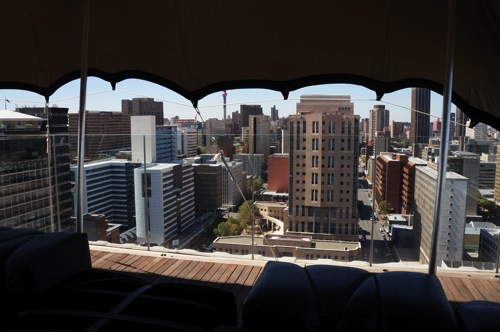
We walk down the street to Randlords, one of the many private rooftop bars dotted around the city. The 22nd floor is one great window to the skyline, currently being set up for a wedding of hundreds. There is an elaborate deck with cushioned beds for lounging behind a glass bannister. There is even a swing for the playful-minded. The views south across the railway lines towards Newtown, east over the green suburbs to Brixton tower and the slag heap remnants of the gold mines, west to Hillbrow and the CBD are stunning, giving us a taste of what's to come.

130406 CBD walk 177
In the midst of the city
We meander our way through Braamfontein to the Rea Vaya bus stop at Park Station at the western end of Braamfontein for our drive to First National Bank in the heart of the city. The Rea Vaya, together with the Gautrain, are Joburg's latest addition to its frankly pathetic public transport system. This is a driving city, and if you can't afford a car, you are reduced to taking the crazy minibuses. They are dangerously driven, overcrowded and feel themselves above traffic rules, but they are cheap and run back and forth to Soweto. The Rea Vaya buses on the other hand have the potential to transform the public transport scene. They run on routes currently serviced by mini taxis, which made them controversial to set up (the mini taxi racket is highly profitable and tightly controlled by private bosses, which led to violent demonstrations, strikes and threats when the bus system was first implemented), but in its own pragmatic fashion the bus company has contracted the routes out to the former mini taxi owners, and employs the taxi drivers as bus drivers. There are still some problems, resulting in shiny new stations being boarded up while contracting disputes are resolved, but in the city at least the buses are running more or less on a schedule.

130406 CBD walk 141
Street trader selling peanuts and underpants
The bus arrives as soon as we get to the station, a cool sleek glass container with ticket barriers at either end. A sign tells us of all the activities that are not allowed at the station: no eating, no hawking, no waiting, no littering, no graffiti, no flyposting, no music, no smoking, no skate boarding, no guns, no dogs. One symbol of a hand is mystifying: No smacking? No waving? No gloves?

All the activities that are not allowed on the Rea Vaya


There is a smart card system in development, but for now we get paper tickets. The clean, new, fast bus (it runs in dedicated lanes through the CBDs grid) takes us downtown to the first of the regenerated areas. The Kerk Street development used to be a rough informal market street, but now has French-style open roofs for the traders and hair braiders stretched along the centre of the pedestrianised street. Both sides are lined with mainstream shops selling fashion like any other shopping street.

130406 CBD walk 116
Braiding supply shops
We stop at the bottom of the street next to a row of fruit and veg stalls to listen to Gerald explain the concept of public area regeneration. The premise is that since the council can't afford to renovate the whole CBD, it would improve the public areas to encourage private capital to come in and take over the run-down buildings. So far the city council has made good on the promise of making the streets of the CBD safer and more pleasant, and slowly businesses are moving back and transforming the dilapidated office blocks, many of which have previously been squatted. It's a huge struggle against the inertia of decay. Despite the new paving, the numerous pieces of street art, the pragmatic accommodation of informal traders, there are still plenty of potholes and broken kerbs. I see some of the grand old city buildings have been rescued or replaced with marble shininess, but there are still plenty of ruins with smoke-blackened window holes, graffiti-covered walls and boarded-up shop doorways. It's a long and slow process. 

130406 CBD walk 128
Hair braiders on Kerk Street
We proceed up Eloff street, once the fashionable shopping mall of the CBD with the most expensive properties, now slowly recovering. The new buildings of First National Bank nearby are bringing flush shoppers back into town. The kerbside is clogged with street stalls selling underpants and socks, bags of sweets and phone credit, cheap jewellery and pens. Women sit on wobbly stools having their hair braided.

130406 CBD walk 137
Markham's Department Store
We hear about the Markham building, an elaborate wrought-iron clock tower topping the oldest department store in the city, about the CNA headquarter, a once stylish five-storey corner block now boarded up and abandoned. We stop at the famous Rissick street post office, built by Paul Kruger to show the British that an Afrikaaner government could be as sophisticated as the Empire. Now a burnt-out shell after a 2009 fire, it was going to be demolished until a campaign to save the historic building forced a rebuilding project. At catty corners sits the grandly white Mutual Insurance building. Equally significant for its Edwardian building style, it, too, was going to be demolished, and will now be renovated and improved.

130406 CBD walk 167
Rissick Street Post Office
This is something of a theme: there seems to be absolutely no sense of architectural heritage here. Amazing historical buildings are simply abandoned until squatters make short work of the structure, and then pulled down to leave an empty lot that can only hope to survive as a parking lot, or have an anonymous glass and granite edifice parked on it. The CBD is filled with ugly sky scrapers from the bad old days of apartheid, the fatally style-deaf 70s have left their legacy, but there are also still some elegant Art Deco affairs, some late Victorian and Edwardian edifices of the Empire age, and some stylish 60s modernist blocks. No-one seems to think it important to preserve them.

Another intriguing architectural style, representative of 60s Apartheid paranoia
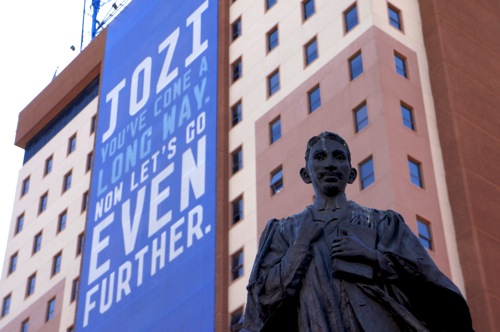
We have arrived in Gandhi Square, a large open space of bus ranks lined by lawyer's offices - the courts are nearby. Behind the bronze statue of the young Gandhi flutters a banner from the current council proclaiming:
 'Jozi, you've come a long way. Now let's go even further.'
130406 CBD walk 186
Gandhi would approve
Much of the regeneration of this historic square has come for the unlikely direction of a law firm (Olitzki) that took over many buildings in 1989 and has been involved in preserving both Gandhi's- he practiced law here before going to India to overthrow the British colonialists - and Mandela's offices - who also practiced law here before his arrest and imprisonment.

The regenerated Ernest Oppenheimer Park
Our walk ends at the Reef hotel, with the funky and cool Gold Reef Cafe on the ground floor. We take in one more sweeping view of the city, this time from an opposite vantage point of the earlier Randlords' view. Gerald takes us through the recent history of the city, explaining the seemingly sudden abandonment of the centre for the suburbs - and the new centre of Sandton. There was an element of self-destruction involved in the legal restrictions imposed by the Apartheid government to control the movements of the black majority. Laws to limit how many black workers an industrial businesses could employ if they had their factory in the city caused major problems. The number was six. With the introduction of the laws manufacturing businesses were forced to relocate. Large factories left the CBD, abandoning the southern area's industrial zone. Pass laws restricted blacks to homelands in rural areas, and only those  that had a job were allowed into the city. Since the factories were forced to move out, there was no access to the city for black workers or shoppers.

130406 CBD walk 193
Chilling on the rooftops
Then, in 1985, president Botha made a famously shocking speech called 'crossing the rubicon': in the face of international pressure instead of liberalising he clamped down on the anti-apartheid movement, made South Africa a military state, and declared a state of emergency. In expectation of the coming sanctions all international businesses left the city, leaving empty offices and ruined support businesses behind. At the same time the city workers left the northern city suburbs of Hillbrow and Yeoville, then bustling middle-class neighbourhoods, following the direction their workplaces had taken. Vast numbers of flats were unoccupied. Landlords keen to keep their income allowed flats to be occupied by poorer tenants, who turned to overcrowding to finance their new homes. The local municipality turned a blind eye because it disagreed with apartheid, allowing the deterioration of properties. In a few short years at the end of the 80s Jozi CBD turned from world metropolis into ravaged slum.

130406 CBD walk 112
A fashion afficionado in Kerk Street
We leave Gerald's tour here to return to Braamfontein, exhausted and enlightened in equal parts by this half day wander through the city. He will take the rest of the group on south and then return to Braamfontein by bus. I am left with a head buzzing with all the new impressions. It seems that every time I brave the CBD I see a new and fascinating part of it. There is the student hipness of Braamfontein, the cultural hub of Newtown, the hip lifestyle centre of Maboneng, the unjustly neglected art gallery and Joubert park. Now I can add the intriguing shopping streets of Kerk and Eloff streets.

You can find more photos in my Flickrstream.
www.flickr.com
You can find an overview of Jozi walks here, my account of a guided walk in Melville here, a Yeoville walk here, an account of instawalking here and my story of photowalking here

22 April 2013

An Easter outing

We pick up Heather at 9am. The sun is blazing, the long weekend is upon us, it's time to get out of town. Hartebespoort Dam is easy to get to, so that's our aim for today. Everyone else seemed to have the same idea, so the little town is busy by the time we get there, the main road clogged with visitors. As the closest resort to both Jozi and Pretoria, Hartebespoort consists of holiday homes and retirement communities. It's all very Afrikaans, as Heather points out, although I can't really tell, a white South African looks like another to me.

130330 Hartebespoort Dam and Pretville outing 501
The signs of autumn are upon us
We have two destinations in mind today, perfect and easily digestible both: the newly renovated cablecar going up the Magaliesberg and the film set of the comedy musical Pretville (Afrikaans link).

Hartie's Cable Car

Cable car first, to avoid the after lunch crush. But when we get there, a queue is already building, the car park full of SUVs and bakkies. Stuart gets tickets while we start queuing up the stairs. The lift was built in 1973 with Swiss equipment and know-how, but closed down in the 80's, only re-opening last year. It's a pretty nice renovation, with a few shops and cafes, clean toilets and an organised system to maximise passengers. A ticket collector checks the queue to match groups to always fill each carriage with six people. Everyone is happy to jump the queue. We wind our way up the ramp until we enter the station hall, a big room open at the end where the carriages slide in and out on overhead wires.

130330 Hartebespoort Dam and Pretville outing 1209

The lift cars are small, green and glassed in. They keep moving as passengers get out and in. We have to swap seats to balance each other's weight, then the car slides off with a big whoosh like a fairground ride. Suddenly, at great speed, we are above the car park, and then above the wild hills. Underneath is a thicket of green trees, red earth, yellow rocks. We gain height and the valley unfolds below us. In the distance the green-blue of the dam blazes in the sun. Behind it low hills point the way to Joburg, while to our right and left the eroded slopes of the Magaliesberg step away from us in geometric uniformity. Below me I can make out a thin path winding uphill. Above me the slack lines of the cable connection hold us in the air.


The threesome opposite us, a couple and their lady friend visiting form Cape Town, smile at our excited exclamations at the view. The visitor was not impressed. Having the table mountain cable car on your doorstep, this must be a comedown. I am intrigued: by the sheer cliffs we pass and the trees growing stubbornly out of a tiny crack in the rocks; by the possibility of seeing animals; by the loud fresh green against the harsh dry red soil.

130330 Hartebespoort Dam and Pretville outing 1294

The ride is over too soon, and we step off the moving cart at the top station. A walkway guides us around and up the hill with pointers along the way. It's hot, with children jostling to climb the rocks on the edge of the hill, nervous parents holding on to their hands to prevent fatal falls. Haartebespoort spreads below us in a hot haze. We can just make out the sailing marina, the main road and blotches of retirement estates.

Pretville

130330 Hartebespoort Dam and Pretville outing 1368
Pretville's hairdresser set

Next we backtrack to Pretville, the film set for a 50s Afrikaans musical. It's an incongruous place, a fake ice-cream coloured confection used to film an all-singing, all-dancing spectacle of history white-washing. While the Group Areas Act was being designed to force families from their homes, the diner served milk shakes and the pharmacy treated babies with colic.


An innocuous-looking police car is parked in the square, dinky and cute. I have the overwhelming sense that it is missing a black offender of the pass laws in the back. The car repair shop lacks an oily labourer, and the tiny prison tucked away behind the children's clothing store really should have been staffed with ANC supporters. The place feels like a lie, all of us white people (unlike the cable car, there are no actual black faces at Pretville) wandering about this movie-glossed version of a reality that never was.

130330 Hartebespoort Dam and Pretville outing 1458
the sweet shop
Unlike the photos in a photo book I saw recently, where the poverty of mind and life, the harsh conditions of the Karoo, the wiry stubbornness and hateful relationships with blacks was clear and unmistakeable, here all the issues have just been airbrushed out of the picture. I guess the 50s in South Africa is just not a a historical period that lends itself to bubblegum entertainment.

130330 Hartebespoort Dam and Pretville outing 1469

On the way home, by way of irony, we passed Diepsloot, one of the biggest 'informal settlements' just north of Joburg. This woman was cutting straw from a fallow field across the township to sell as roofing material. No pink here.

You can see more photos on Flickr:


www.flickr.com

13 February 2013

A stroll through Yeoville

130209YeovilleandPonte-68-2013-02-13-19-26.jpg
The View from Observatory Hill towards Hillbrow
Going for a stroll through Johannesburg's neighbourhoods might seem to be an unlikely occupation for a sunny Saturday, specially when the destination is Yeoville, former bohemian hotspot and more recently decried as a symbol for the downfall of the city: "Dangerous. Full of criminal elements. Dirty. Rundown. Ruined." These are some of the more polite things said about Yeoville. Well, I have already been to Hillbrow, Soweto, Joubert Park, the Carlton Centre and other parts of town that I have been told are all these things, and I enjoyed every one of them.

130209YeovilleandPonte-35-2013-02-13-19-26.jpg
Public Art
So last Saturday Heather introduced me to Jozi's latest walking tour outfit: Nick and Loopy from Dlala Nje (Just Play in Zulu). Dlala Nje (their website is not live yet, so for more info go to Urban Joburg’s blog) is a cafe and art place in one of the empty shops at Ponte City, the iconic circular building on a hill in Berea/Hillbrow (more on Ponte another day - I'll just say the photos are amazing...). They have been running Hillbrow tours since October, but are now branching out to Yeoville.

130209YeovilleandPonte-71-2013-02-13-19-26.jpg
Saturday worshippers on Observatory Hill
We first walk up to Observatory Hill, from where we have a great view of the CBD and Ponte. The park - if it can be called that - on the hill is pretty rough, with aloe clumps and high weeds in every dip. In between the grass has been shorn, and despite the cleaning crew still dotted with rubbish. Under a tree a huge pile of old tyres have accumulated. It's Saturday, and the hillside is filled with groups of worshippers. On the edge of the hill a man in a white tunic on his knees is blessing the young man kneeling opposite him, his hands on the other's head. Nearby a woman and small child sit, watching. Under a tree a priest kneels, hands pressed tightly together. He doesn't seem to have a congregation. Below us on a slope a dozen people stand listening to a grey-haired man telling serious parables with a furrowed brow. Off to one side a woman is playing with a small toddler, head covered under a blanket to keep out the sun. She looks the picture of Mary and the (unruly) Child. A man in a jogging outfit is sitting by himself far down the slopes. Arms wrapped around his knees, he is lost in thoughts.

130209YeovilleandPonte-80-2013-02-13-19-26.jpg
Westminster Mansions
Just across from the hill, amidst the relative poverty of Yeoville and Observatory Hill sits Westminster Mansions. A confection of turrets and pillars, balustrades and balconies in cream and magnolia, it makes an incongruous impression. A grand entrance draped in barbed wire and the admonishing signs of security companies speak of an illustrious history fallen to ruin. We look up at the block, teetering precariously on the slope of the hill, and imagine the magnificent views of a city that has stumbled, trying to right itself. I guess the inhabitants must be still there, waiting for that day.

130209YeovilleandPonte-48-2013-02-13-19-26.jpg
The cleaning ladies were keen to have their photo taken
Past the water tower we descend into Yeoville proper. At first the gridded streets have the relatively serene look of suburbia, single-storey houses such as the ones I see all over the colonies: porch, small front garden behind a street-side fence or wall, a car port to the side. Streets are lined with Jacarandas, quiet and shady. Then I notice that many street-facing walls have been modified with a cubby hole that is used as a little shop, called a Spaza. There one can buy anything from airtime to bananas, washing powder and bread. Some houses advertise their use as hair salons or car mechanics, undertakers or key cutters.

130209YeovilleandPonte-42-2013-02-13-19-26.jpg
A Spaza shop
We arrive in Yeo street and Nick tells us that Yeoville was founded in 1890 by an Englishman named Thomas Yeo Sherwell from Yeovil in Somerset. The idea was to create a neighbourhood with clean air far above the smelly coal town in the valley, but the location didn't take off until the 1970s, when it became a hip bohemian area designated a 'grey zone' by the apartheid government, meaning it was inhabited by black and white homes. There were jazz clubs and bookshops, arts and crafts outlets and cool clothes shops, as well as drugs and crime on its main thoroughfare, Rockey Street. After the end of Apartheid the demographic shifted from 85% white to 90% black within a decade, while urban maintenance disappeared.

130209YeovilleandPonte-109-2013-02-13-19-26.JPG
One of the few pictures I managed to grab before the security guards arrived
As we walk into the busy Main Street area around the Yeoville market, it is clear that today's Yeoville is a very different place. Street traders sell anything from water to sweets to airtime to fruit. It is not so busy, but we are certainly an unusual attraction. The market is fantastic, more Nairobi than Rosebank: rows of fruit and veg stalls, clothes stalls selling bright chichenji fabrics, tables spread with soap and makeup. Under cover in the central alleyway of the market an old woman sits on a stool amidst the equipment required to roast peanuts. She swirls the hot steaming peanuts in a large plastic bowl, sprinkles them with salt and carefully tips them into small R3 plastic bags. The peanuts are tiny and delicious. I buy nectarines and grapes and plums, ripe and juicy. I want to stock up on aubergines, tiny peppers, plantains, sweet potatoes, but I hold back since I have to carry everything. Security guards are everywhere, warning us not to take photos. It is disappointing, as most traders don't seem to care, but reassuring that someone is looking out for calm and peace.

130209YeovilleandPonte-113-2013-02-13-19-26.jpg
Desire, one of the Dlala Nje artists, at Yeoville pool
We trundle our way along the main road, discovering one unlikely place after another: on the corner of Raleigh and Kenmere is the entrance to the Yeoville swimming pool, filled with kids gleefully jumping in the cool waters. Glorious 1930s flats line the street, with stylish balconies and cool fonts spelling out the name of the block. We are almost in Hillbrow now. Berea, Hillbrow and Yeoville all merge together into one of the densely populated areas of Africa, and it shows. The streets are heaving with people now in the afternoon, and the bars are filled with early starting drinkers.

130209YeovilleandPonte-135-2013-02-13-19-26.jpg
Stylish local architecture, cool fonts
Wandering the 'bad' parts of town has been an eye-opener. As always, when I discover yet another 'no-go zone' that turns out to be not so no-go after all, I realise: I love you, Jozi!

More photos here:


www.flickr.com
fiverlocker's items tagged with Yeoville More of fiverlocker's stuff tagged with Yeoville

09 February 2013

This day in history: Photowalks

Photowalker at the wishing tree
This is going to be a new series of post. Why? Because I have not blogged when things happened, so now I write about them in hindsight. That way I don't feel that I am so very very late with my writings, and I can still talk about the events I want to talk about... 

Cinema becomes church - suspension of disbelief continues
I can see that a year ago this month I went on my first and second photo walk. For those not in the know, the photowalkers are a Johannesburg group (do they exist anywhere else? I have never noticed them before, but who knows...) of amateur and pro photographers who walk the streets of Joburg and its surrounds in search of a good shot. The group has been going since 2009 and was founded by Mark Straw, who seems to have an indefatigable enthusiasm for devising new and interesting places to visit. 

Giving out New Year's good luck charms

Chinese New Year

My first event was the Chinese New Year celebrations in Bronkhorstspruit at the Nan Hua Temple. Heather, who first mentioned the whole photowalker concept to me, assured me that everyone would be friendly, and that she would introduce me. As it turned out we never even met any photo walkers, although they were surely there, because the temple was crowded with visitors.

All kinds of food for sale
The centre square of the temple was used for dragon puppetry, fireworks and general celebration, while the walkway around the square was crammed with stalls selling everything from massages to orchids, swords to dumplings. The temple itself was a quiet centre of the proceedings, where we could sit and take things in. 
Just outside the front entrance was a wishing tree festooned with ribbons where people left their wishes for the new year. Photo opportunities abounded. Even though we didn't meet the photo walkers, we came away with a haul of good pictures.

Art Deco Photowalk


The splendid Benoni Springs Fire Station (thanks, Anonymous)
It was on the next photowalk where I really got into the whole thing. Meeting in the morning at a mall in East Joburg, about twenty people divided up into cars for the ride out to Springs for the first part of an architectural tour of Joburg's satellite towns. 

Photowalker in action
A local architect showed us the art deco treasures of Springs: the town hall, local schools and private houses, and on the main street a cinema turned church as well as rows of shops and warehouses - all sporting fabulous Art Deco styling. 

Glorious Art Deco in Benoni
We ended up at a locally famous ice cream parlour where we got to go into the inner sanctum, where the delicious ice cream was made. The rest of the day was spent at Benoni where a splendidly designed fire station kept us occupied for quite a while. 

I spend a lot of time walking around cities (and the countryside) photographing what I see. I guess that makes me an urban photographer. The difference between going for a walk on my own and a photowalk is like night and day: In a group there is the challenge to catch that shot that no-one else did, find an angle that no-one else has. 

But it's not just competition. In a new place I am always fascinated when I see someone else take a picture. I creep up behind them and try to work out if they have discovered an interesting subject, what it is they are looking at. On a photowalk that is multiplied, because we all stand behind each other looking at the others' shots, wondering if we can capture something worthwhile, but different. It's a constant pushing and intensifying, scrutinising and questioning of the current view point. What else is there? How else can I capture this? What am I missing?

Want to go photowalking?

Blast from the past - analog photos
A Pentax K1000 in the wild
Photowalkers also use a wide range of cameras. There are the standard digital SLRs equipped with a range of lenses from fish eye to telephoto, but there is also the iPhone, the Helga, the old-school Pentax K-1000 with an external view finder. There is a refreshing lack of snobbishness around equipment, a mutual interest in each other's choices.

Best thing about photowalking? Going to places I either didn't know existed, or wouldn't have been brave enough to visit by myself. Joburg photowalkers are on Meetup, and as it turns out so are a bunch of other photowalking groups, so there is no excuse not to get involved.

More photos here: 

2012 Chinese New Year


www.flickr.com
fiverlocker's 2012 Chinese New Year photoset fiverlocker's 2012 Chinese New Year photoset

Art Deco Photowalk


www.flickr.com
fiverlocker's Art Deco Photowalk photoset fiverlocker's Art Deco Photowalk photoset