A man lived with his wife and two dogs and three cats in a village in the north of Germany. He ran a small business and in his spare time he took out his pony and trap, driving the long straight field tracks among cows and corn.
When he found out that his village of 500 inhabitants was going to house 27 refugees in a house next door, instead of worrying about terrorists and crime and headscarves he volunteered to organise a donation drive. The council would provide the house with beds and refrigerators and wardrobes, the bare minimum, and the village would provide the rest.
Within two weeks the villagers had collected crockery, TVs, sofas, towels, games and mops, coffee machines and bedside lamps and blankets and spare bedding. Everything in fact that makes a dormitory into a home. One evening twenty people arrived to unpack and sort, to carry furniture and stock kitchen cupboards, to hang pictures and set up stereos. By the end of the evening the three flats in the house had been made homely, welcoming. They are now organising German lessons, driving rotas and legal help. The man is my brother. I am very proud of him.
I am currently writing a book about my mother's wartime experience. The centre piece is turning out to be their fearful evacuation to the east of Germany and her return home in flight ahead of the Russian army.
In 1945 she walked, separated from her parents and sister, hundreds of kilometres to escape the devastation, dependent on the kindness of strangers. She was twelve. She died last year. I like to think our support for refugees today is also done in her memory.
Meanwhile, back in Germany spring has sprung. Crossing continents and seasons, we get a chance to wander from autumn in the South African Karoo, with its freezing starry nights and clear still days, to the fresh green of suburban German parks, tame and organised for the enjoyment of dog walkers and weekend cyclists.
I take a walk through the strips of forest and fields bordering Recklinghausen, a medieval town turned mining centre in the industrial heartland of the Ruhrgebiet. Here slag heaps and steels mills rub up against horse paddocks and wheat fields, the old heavy industry threaded through with recovering wilderness and neat parks.
Mark, my walking companion, has lived here all his life, jogging, dog walking and mountain biking from Düsseldorf to Dortmund. When I ask how he knows where the nice walking is and how he doesn't end up in the grotty industrial estate by accident, he explains that there are regional hiking organisations ensuring the quality of the walking paths all across the country. A 'Wegwart' (path orderly) regularly hikes all the routes to check the signage, looks for fallen trees after rains or storms, controls the cleanliness of the path, marks unruly plant growth. This person is responsible for renewing the complex routing signs, which distinguishes between loops, A to B routes and long-distance tracks. They also record any maintenance work and damage for the local council to rectify.
Mark tells me that to become a Wegwart one as to attend seminars where one learns the correct way to attach a route sign to a lamp post, the appropriate paint to use for marking potholes, the minimum requirements for safe passage to avoid lawsuits from injured hikers. An up and coming Wegwart has to pass an exam or two to show their competence. It they conduct themselves properly they are eventually given expanded route networks and may even be allowed to train other wannabe Wegwarts. It strikes me that the German hiking groups have managed to turn a mildly enjoyable hobby - going for a walk - into an unpleasant chore, complete with studying for exams and the stress of having to work at what was once relaxation. How very German.
Since it's Mayday I have discovered another strange German tradition: troops of friends (mostly youngsters) drag a wheeled trolley around with them while drinking beer and listening to the loud music blaring from the stereo on the trolley. Apparently it's entertaining to walk around the neighbourhood and parks all day while drinking.
And last but not least we shop at the local farm store for freshly cut asparagus and new potatoes for our dinner. Asparagus season is taken very seriously here, with recipes traded as treasures, asparagus festivals and wines that match the most popular recipe of asparagus, new potatoes, slices of ham and Hollandaise sauce. A perfect combination, I think. And asparagus season is over far too soon, so we stuff ourselves at dinner time.
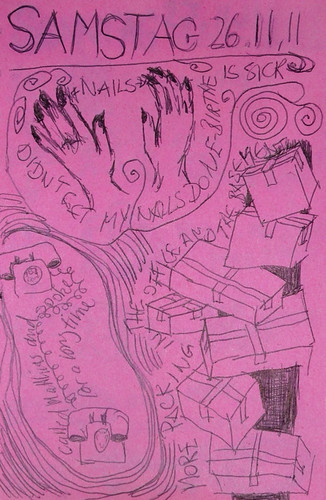
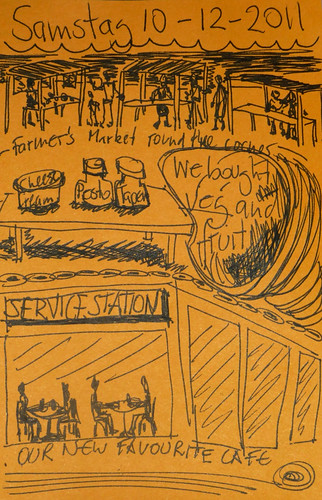
So what with the house move and travelling and writing the book (more on that later) I find myself short of time to keep up my diary. I have been writing it since I was fourteen, and I am not about to pack it in now, but for the time being I am looking for a quicker outlet. So I came up with keeping a visual diary, a quick drawing of events every day. It also keeps me in sketching mode, something I have neglected criminally in the last few years, and allows me to practice drawing. I focus on three major events of the day (not as easy as it sounds, I've had a lot going on lately) and try to visualise them. My naturalistic drawing of objects has always been quite terrible, ditto faces and bodies, but I am not letting that stop me. Here are more samples. The sketchbook gives me background colours, but I have decided to move on to a daily calendar type book from January 1st.
It's been almost two years (and too few entries on this blog, alas), so it's about time we moved on from Germany. Packing up our stuff has become a well-rehearsed affair, the only novelty lies in the items we sell off this time and whether everything goes into storage or gets shipped immediately to the new destination.
This is my third attempt at living in Germany, maybe my last. What will I miss when I leave?
The bread, dark and heavy with grains, sold by the local baker women who are almost friendly after all this time of me shopping there every day.
The eco-greengrocer round the corner and the fresh produce, including the wide variety of cabbage, root vegetables and apples. Despite being open at seemingly random hours and only taking cash, I always look forward to checking out the season's fruit and veg.
The Folkwangmuseum. Once dubbed 'The Most Beautiful Museum in the World', it is glamorous, airy, and full of amazing Expressionist art. Shame about the cafe that can only be visited after paying the entrance fee.
Popping in to my mum's on a whim, for a cup of tea and a long chat. Anytime.
Trains that run on time. Really, they are! And cheap, clean and stylish to boot. How romantic to know that I can get to Berlin, Moscow, Vienna, without even changing, directly from Essen Hauptbahnhof. Not to forget the iPhone app that let's me look up timetables, the BahnCard that gives me money off the ticket, and the promptly answered phone line with accurate information. Take that, British Rail!
Our glorious flat, the big windows with the hot summer view over the forest, the long desk in the office, the projector and screen for watching movies on the squishy sofa.
We went flying today, now that Stuart has his license current again. This is first time I have seen the Ruhrgebiet from the air. It's hard to describe how I felt, privileged and awed, surprised at the shape this conurbation takes from the air. Travelling around it on the ground, despite the frequent fields and parks, the Ruhrgebiet feels like a big city, Bottrop joined to Oberhausen which is inseparable from Essen, which is invisibly connected to Bochum, which slowly seeps into Dortmund and so on. From the air there really is no join at all, our navigation takes place along the grid of motorways and canals: the A2 to the North, the Rhine to the West, Ruhr to the South, and Dortmund airspace preventing us from going too far to the East. In between we discover a mass of surprises: The vast swathe cut by the Rhine-Herne canal which is mostly invisible from the road, a fat waterway filled with barges and edged by industrial sites, and the occasional marina;
Canal lock near Gelsenkirchen
I had no idea that they were still working mines, or related coal industry, and there they are, mine shaft elevators, smoking chimneys, black coal heaps. And right next to the filth vast fields are being shorn of their wheat, as if we weren't in the middle of an industrial belt. The local mountain scenery of slag heaps, those monuments to the local past consisting of steel making waste and toxic left overs of the coke industry are not as visible as I expected, as overwhelming as they are when driving along a road only to have a sudden hill rearing up off the plains. I guess landscape flattens out from this high angle. Those slag heaps that have been crowned by a post modern artifice like a wind turbine or Recklinghausen's horizon observatory stick out, the rest melt into the general park/forest/nature area, covered as they are in mature trees and other old vegetation.
Horizon observatory in Recklinghausen
There were surprises like the extensive prison site right near the A42 motorway that no one has ever noticed before, or the strange industrial shapes of water towers, gas containers, coal trains and water clearance ponds. And bridges. There are many, across train lines, canals, rivers and roads, and many are architectural fancies with colourful lines and abstract swirls. Or naturalistic ones, like the dragon bridge in Recklinghausen.
Of course we spend some time house spotting, looking for my mum's house, my brother's. Our own is unfortunately directly below us as we approach finals on the airfield, therefore invisible. We missed many other places of interest, so there will be another flight soon.
And suddenly I am realising that this may, after all my professing that I am a European, a World nomad, that I don't belong to a place, after all that this may be my home. Although I am not sure yet.
Ok, it's been 2 months since our return to civilisation (63 days, to be precise), and it's time to clean up this blog. Going back to normal means that the route, the blog roll and the photos will have to go, so does the calendar and other trip-related links.
But, just in case they come in handy in future, I am not going to delete them as such, instead I will park them in this blog post for future reference.
Warning: This blog entry contains many German words. This is intentional - I haven't suddenly lost the ability to write the English language. If you want to know what they mean, look them up.
After Etosha we are heading to Botswana, via a small town called Tsumeb. The savannah of Etosha had given way to woodland and some hills, the trees showing an amazing range of colours in their leaves, from bare grey branches to reddish brown and dark green leaves, silvery shades and yellow leaves where the sun has bleached the growth. Tsumeb is a small mining town with a very big mine. The mine had closed 18 years ago and the town was now trying to find a purpose serving the farming community. Mining in Tsumeb was for minerals, metals and crystals, a crazy mix of materials pushed up in a pipe during the making of the world. MAny minerals are only found here, and the crystals and gems have made-up names like Tennantite and Anglesite, or sponsored names like Smithsonite. Down Main Street, past signs for the Copper festival, the Youth Festival and the banner announcing Karnival (at the end of July?!?) we came to the jewel of the town, the Tsumeb Museum: "Ethnological-colonial and mine history under one roof!". Entering it I found myself returned to the old Heimatmuseum in Bottrop, with an African twist. The lady at the desk spoke German, of course, and the rooms were labelled in German, Afrikaans and English, displaying the utterly complete German influence on the town despite the fact that the Germans surrendered to the Brits in 1915 and never regained Namibia as a colony. The museum rooms resemble nothing more than the average German Heimatmuseum, polished wooden display cases filled with dusty, badly labelled artefacts: diaoramas illustrating 'traditional life' (in this case a Herero village) built from found materials by a volunteer, trees fashioned from cotton balls dyed green and held up with brown sticks; fading photographs and educational writing taped to the walls; jewellery displayed on inappropriately coloured mannequin heads; old medals and war uniforms labelled with the donor's name.
The 'mine display room' was copied directly from the Bottrop museum, showing as it did the mine worker's implements, a Gesellenstück made for an exam in the shape of a parrot, but really a cigar cutter; charts and maps of the mine payout, models of the mine workings and photos of Victorian families and their black servants at Christmas. Then there were targets from the Schützenfest, medals from the Reit und Fahrverein, trophies for the Kegelmeister, a banner from the Männerturnverein and costumes from the Karnevalsverein. Also Pfadfinder flags and Mark pieces of the official Otavi mine currency, to keep people's pay in the family, so to speak. It could not have been more German if it tried.
We left Tsumeb eating Apfel und Karottenkuchen from the Etosha Cafe and Biergarten.
I can't begin to explain in how many ways Skype is keeping us connected right now and how much we are going to rely on it on the trip. We have had an account with Skype for years, although we had a bumpy start when they ate some credit of mine a few years back. But lately it has got more and more handy.
To start with we use SkypeIn, which gives us three local numbers in different countries. We have a landline number in Germany my family can call, one in the UK for Stuart's family and our friends, and one in Wellington for Merryl's gang and everyone we keep in touch with there. This means that people in those countries only have to call a landline in their country, not the expensive South African number. As a result people actually call us, which makes us feel more wanted ;-)
The money we spent on a Skype phone that doubles as a landline (it's hands-free and the base station connects to the router. Looks just like a normal phone) has been so worth it. All our international calls go through SkypeOut, where we pay a monthly fee for free calls to lots of countries. Stuart can make his conference calls, I can chat with my mum - brilliant. The phone displays all the Skype contacts which sync with Addressbook on the Mac, so we don't have to type in numbers. It also displays voicemails and any missed calls we receive via Skype. This alone has made it so much easier to use Skype to make calls. Before I was never logged in on the computer at the right time, and the sound quality is just like a normal landline call without having to dig out the headphones.
When we are on the road, we will have a satellite phone for emergencies, but people will still be able to leave us messages on voicemail, and since we get an email notification we can actually respond when anyone pings us. I am also hoping that we will be able to make use of Skype on the iPhone when we are at a hotel or other place with wifi.
I know this all sounds like a sales pitch, but after years of not really seeing the point (we had 2 hour long international calls for NZ$5 from New Zealand and pretty cheap rates from Dubai to most of Europe, so weren't too bothered so far) I am now a total convert. The only problem is that calls to Dubai are still really expensive, so it's not been an option to call anyone there.
Stuart is trying to learn German in preparation for our move to Germany, but the more I walk around this country and read its magazines and newspapers, the more I despair of still having a language in the long term. English slogans and terminology has become de rigeur for adverts and journalism. I read about "wirelessen" and "cloud computing" and every town needs an English slogan. The magazine above actually has content written entirely in German, not that you would be able to tell from the cover.
This use of another language doesn't always end well, of course, and apostrophe crime is rife, as is the use of words strung together with little concern for content or indeed meaning:
I really have no idea what this means and how it relates to fashion. Can you take a guess?
So I am returning from a weekend in England on a flight that is arriving late into Düsseldorf at 10.30pm. It's a good hour on the train till I get to my bed at the best of times and now it's late at night. I am prepared to spend 80€ on a taxi. As it turns out there is a regional train with one change to Recklinghausen AND a bus that will get me to within 5 minutes walk from home. All for 10€! Pretty cool.
And that's not even to talk about the fact that you can buy an all areas ticket for the month for about 80€ - which even let's you take friends along for free on the weekends. Or the cool Fahrplan (Link opens iTunes) iPhone app that can tell you where the nearest bus stop is and what time the next bus is due. I have always been convinced of the value of public transport. It is an efficient way to move people, it keeps down pollution and gives me time to read and think.
Fairs are great. They happen at every -generally catholic - holiday, Easter, carnival, All Saints, specially around spring and autumn times, as if to bracket the outdoor and indoor parts of the year. There are rides, of course, big swirly scary gravity-defying ones that make me green round the edges just looking at them, neon lit with speeds too fast for the human organism; old-fashioned slower ones that are more my thing: the big wheel, bumper cars, Kettenkarussell (the one that looks like a spinning top with seats on chains hanging from the sides).
And candy floss, candy apples (I prefer their German name Paradiesapfel: apple of paradise), chocolate waffles, ice cream, licorice and if I'm really lucky, Turkish Honey.
As a bonus this time we had a firework display. Brill!
Mineral water in crates. You return them to a machine that counts how many bottles you have and gives you your deposit back. All sorts of recycling including batteries. There are collection boxes in the shops next to the rack of new batteries. Brilliant. Train stations and airports have bins where you can separate paper, plastic and cans.
First of all I have to say that this is a new experience for me. Loving anything about Germany has taken me about 20 years of living somewhere else in the World. But there is one thing I learnt: nobody makes rolls like German bakers. I have no idea why. Cake, bread, anything else you can get in other places, different styles, but just as good. Not so rolls. They are crunchy on the outside and soft inside. Yum. And I'm not saying this because I have a baker in the family nowadays.
I am taken back 30 years to my youthful job hunting days visiting the Arbeitsamt. Today it's the Rathaus to apply for a passport to fill up with African stamps later this year. There is something uniquely grim and sober about those corridors. When the rain pelts down outside and it's never going to be spring again I wonder whether it's possible to have efficiency without Kafkaesque architecture.
A week in France, a week in Germany. Sounds simple, but isn't.
We visited the boat to check on it, but I was so ill with a flu that I am convinced I picked up from some visitor to the film festival (where else? All that air-conditioned proximity to people from all over the World) that I didn't notice much of the clear sunny skies and beautiful winter light.
Germany was freezing, partly due to the fact that my brother doesn't think much of central heating. And partly probably because we are getting used to such mild temperatures that we forget to pack truly warm winter clothes. But it was still a great way to spend Christmas, it snowed and we had a proper full-sized tree with decorations and candles, lovely dinners were cooked by Ellen, Matthias and Vera and we even played card games. How very old-fashioned.
Proper Christmas
It all started out quite harmless, but ended with a 5-day stay in hospital.
Summer in Germany, a tradition for me now for the last two decades. Visit family, hang out with old friends, do some Germany-specific shopping (shoes in large sizes, green frogs, proper bread, that sort of thing). Pretty standard. Unfortunately this year was a little different. I had been having back pains all year on and off, as it turned out when I finally want to see a doctor at the beginning of my visit, I had been carrying a gallstone of immense proportions and it had to come out, inclusive of gall bladder. So what started as a few weeks respite from the heat ended up with a hospital stay and two weeks of recovery afterwards.
But it wasn't all bad. I got to spend a few days in London with Alex, Jason and Fay, combining this with a whistle-stop tour of some of London's major exhibition spaces (Rebecca Horn at the Hayward, Frida Kahlo and 70's installations at Tate Modern). London was under a cloud of fraught emotions at the time, a few days after the Underground bombings of July 7th, but seeing friends and good weather made up for it.
I also managed to spend time in Weener with Matthias, Ellen and Luca. They have settled in fabulously well at their new house by the port, surrounded by boats, sheep and assorted tourists. This summer they were inundated with visitors taking the opportunity to see the sea (or at least the Elbe) and take in the clean North Sea air.




 Proper Christmas