Showing posts with label art. Show all posts

31 January 2014

A spiritual journey

I’m reading Ken Follett’s Pillars of the Earth right now, which inspired me to learn more about cathedral building. As it turns out he wrote the book for the same reason. He grew up in a born-again Christian family and never entered a church in his childhood. When he visited Winchester cathedral for the first time, he became obsessed, turning into a cathedral nerd. The book is very descriptive on the process of building a church of that size in the 12th century, detailing not just the design and building process, but everything from funding to politics.
Armed with a book on How to Read Buildings (subtitled “A crash course in architecture”), we braved the rain and high winds of yet another winter storm and drove the hour and a half to Winchester. We threaded our way between the South Downs on our left and the seaside resorts of the chalk coast on our right to Portsmouth, then turned inland to Winchester. Only last week we watched a BBC documentary on King Alfred, considered the first Anglo-Saxon king (whose bones were interred in the old minster which used to sit right next to where the new cathedral now rises), so the huge statue of him with sword raised in battle on a plinth at the entrance to the city didn’t come as a surprise. What was a surprise was the massive size of the cathedral.
We ducked into the front door out of the driving rain, shivering with cold. I was regretting going out at all instead of sitting on the sofa with a cup of tea and my knitting. An afternoon spent in a cavernous and chilly cathedral seemed like bad judgement. But when I pushed back my rain hood and lifted my eyes, I forgot my damp jeans and freezing fingers. My grumpy thoughts were replaced by awe. I stood at one end of a ginormous, vaulted hall. Large grey brown flag stones spread under my feet, frequently interrupted by granite black grave markers. Over my head the span of gothic fan ceiling seemed as far away as heaven. At the far end of the space I could just make out an intricately carved wooden separator. Pillars marched away from my viewpoint on either side of the wide empty nave. In winter the cathedral is emptied of seating to present the church in the way it was intended to be seen: a vast, impressive display of celestial power manifested through the local bishop, a place to marvel at human achievement in the name of god. It brought tears to my eyes.
Mini monks praying for their bishop
Reading The Ken Follett book I have a fresh image of life in the 13th century. Winchester cathedral was built at just that time. I squinted, trying to imagine how the building work might have been achieved. The height of the barrel vault made it seem impossible to construct with just the use of wooden scaffolding. How would the masons been able to span the pillars lining the nave to construct the centring that holds up the stone arch as the mortar dries? How would they have lifted up the heavy carved keystones? How would they have calculated the depth of the foundations and weight of the buttresses to steady the aisle walls so the ceiling didn't collapse? Now that I know the primitive materials and tools they worked with it seems even more miraculous that these cathedrals were ever built.
At first we wandered along the aisles, reading the grave markers and memorial plates. While looking for Jane Austen, who was buried here in an early morning ceremony (church service was at 10, so the funeral had to be done by then), we discovered many fascinating people: the officer who drowned after his supply ship blew up and sank during one of the colonial wars of the 19th century; the wife of a dean who described her virtues at great length despite starting by saying: "words cannot describe her"; the smart and kind and ambitious women whose accomplishments can only be read between the lines of 'feminine character' and 'extraordinary mind'; the officer described as 'angler, thinker, soldier'.
Jane Austen's memorial plaque
We found Jane Austen's grave. The stone plate makes no mention of her profession. She was not well regarded as a writer when she died, two of her books being published posthumously. But there are two more memorials to her, witness to her rising population as the 19th century discovered her skills: a brass plaque paid for by her nephew, who wrote her biography and praised her writing, and a later stained glass window funded by public subscription. The window depicts oblique references to her, such as St. John and his gospel which starts with: "In the beginning was the word..."
A screen of holy fruit: figs, grapes, pomegranate
We found other treasures in our slow meander through the cathedral: the largest medieval tiled floor, faded patterns of terracotta and cream; a bishops grave, three gnome-sized monks sitting at his feet praying; another grave, this one a Vanitas, with a gruesome skeleton topping the coffin instead of an elaborately dressed clergyman; a Romanesque transept, so different in its squat style from the elegant gothic - an opportunity to crack open the architecture book and learn something about rib vaults and shouldered arches and moulded capitals.

19 May 2013

Songs of Migration

A trip to the to the theatre. In Jozi it's my first time. While I visit the theatre in the UK frequently, I am not in step with the venues and schedules of shows here. My impression so far has been that there is the famous Market Theatre, fabled point of resistance against apartheid (but I have no idea what quality of shows they put on now) and a load of touring shows from Europe and the US, interspersed with Afrikaans comedies and bland Whitney Houston impersonators. It turns out I couldn't have been more wrong.

The Joburg Theatre is a big 70s building at the top of Braamfontein. I don't know what I had been expecting, but the space is massive, more South Bank than regional playhouse. A grand entrance hall with escalators, high ceilings, a cafe and lots of room for mingling outside the vast auditorium.
130228 Hugh Masekela 69
We had come to see Hugh Masekela's production of Songs of Migration, a story of the African experience, where men and women frequently travel long distances to find work, away from home for months and years.
The audience was overwhelmingly black, and raucous. Whether that's because there were local drama students in the cast, and the whole balcony seemed to be filled with friends and family, cheering every nifty turn and perfectly pitched note, or that the material generally invited calls and participation, I am not sure. It made for a lively atmosphere.
130228 Hugh Masekela 63
As soon as the performance started I realised that it would be even better than I expected. The cast of 20-odd was impressive, all singing with individual voices, dancing superbly, and performing without the over-acting that often happens with performers primarily trained as singers. The whole show was narrated by the indefatigable Hugh Masekela, dressed in a snazzy black and purple suit and a loud tie. He threw in amazing trumpet solos, all improvised. The guy is 74, but he performs and dances like a much younger guy. It was a joy to see him sing at the top of his voice, to boogie with the much younger women, to dance his peculiar style: he bends his knees low, almost kneeling, and walks with a groovy shuffle that Michael Jackson could have learned from.
130228 Hugh Masekela 70
The locally famous Gloria Bosman, a soul/opera diva with an interesting choice of boldly patterned dresses, is his partner on stage. They take turns narrating the lives of poor workers flocking from the country to the city in search of work in the mines (for men) and as housekeepers (for women), of the people left behind, and of the people travelling from faraway places to South Africa to improve their lot, to flee persecution and war.
130228 Hugh Masekela 73
For most of the first half I was quite lost, as most of the songs were in either Khosa, Zulu or Sesotho, so I was guessing the meaning of the story from the acting, and the occasional narration in English.Even the old Apartheid SA flag hoisted as a backdrop wasn't familiar to me. I just let the songs flood over me, enjoying the moment and slight dizziness of confusion. In the interval Moeketse and Corlette, my South African friends, explained the jokes that everyone laughed at, like the young man courting a girl while wiggling suggestively and it seemed involuntarily. Apparently there is a kind of herbal Viagra, which is popular and much joked about. 

22 April 2013

An Easter outing

We pick up Heather at 9am. The sun is blazing, the long weekend is upon us, it's time to get out of town. Hartebespoort Dam is easy to get to, so that's our aim for today. Everyone else seemed to have the same idea, so the little town is busy by the time we get there, the main road clogged with visitors. As the closest resort to both Jozi and Pretoria, Hartebespoort consists of holiday homes and retirement communities. It's all very Afrikaans, as Heather points out, although I can't really tell, a white South African looks like another to me.

130330 Hartebespoort Dam and Pretville outing 501
The signs of autumn are upon us
We have two destinations in mind today, perfect and easily digestible both: the newly renovated cablecar going up the Magaliesberg and the film set of the comedy musical Pretville (Afrikaans link).

Hartie's Cable Car

Cable car first, to avoid the after lunch crush. But when we get there, a queue is already building, the car park full of SUVs and bakkies. Stuart gets tickets while we start queuing up the stairs. The lift was built in 1973 with Swiss equipment and know-how, but closed down in the 80's, only re-opening last year. It's a pretty nice renovation, with a few shops and cafes, clean toilets and an organised system to maximise passengers. A ticket collector checks the queue to match groups to always fill each carriage with six people. Everyone is happy to jump the queue. We wind our way up the ramp until we enter the station hall, a big room open at the end where the carriages slide in and out on overhead wires.

130330 Hartebespoort Dam and Pretville outing 1209

The lift cars are small, green and glassed in. They keep moving as passengers get out and in. We have to swap seats to balance each other's weight, then the car slides off with a big whoosh like a fairground ride. Suddenly, at great speed, we are above the car park, and then above the wild hills. Underneath is a thicket of green trees, red earth, yellow rocks. We gain height and the valley unfolds below us. In the distance the green-blue of the dam blazes in the sun. Behind it low hills point the way to Joburg, while to our right and left the eroded slopes of the Magaliesberg step away from us in geometric uniformity. Below me I can make out a thin path winding uphill. Above me the slack lines of the cable connection hold us in the air.


The threesome opposite us, a couple and their lady friend visiting form Cape Town, smile at our excited exclamations at the view. The visitor was not impressed. Having the table mountain cable car on your doorstep, this must be a comedown. I am intrigued: by the sheer cliffs we pass and the trees growing stubbornly out of a tiny crack in the rocks; by the possibility of seeing animals; by the loud fresh green against the harsh dry red soil.

130330 Hartebespoort Dam and Pretville outing 1294

The ride is over too soon, and we step off the moving cart at the top station. A walkway guides us around and up the hill with pointers along the way. It's hot, with children jostling to climb the rocks on the edge of the hill, nervous parents holding on to their hands to prevent fatal falls. Haartebespoort spreads below us in a hot haze. We can just make out the sailing marina, the main road and blotches of retirement estates.

Pretville

130330 Hartebespoort Dam and Pretville outing 1368
Pretville's hairdresser set

Next we backtrack to Pretville, the film set for a 50s Afrikaans musical. It's an incongruous place, a fake ice-cream coloured confection used to film an all-singing, all-dancing spectacle of history white-washing. While the Group Areas Act was being designed to force families from their homes, the diner served milk shakes and the pharmacy treated babies with colic.


An innocuous-looking police car is parked in the square, dinky and cute. I have the overwhelming sense that it is missing a black offender of the pass laws in the back. The car repair shop lacks an oily labourer, and the tiny prison tucked away behind the children's clothing store really should have been staffed with ANC supporters. The place feels like a lie, all of us white people (unlike the cable car, there are no actual black faces at Pretville) wandering about this movie-glossed version of a reality that never was.

130330 Hartebespoort Dam and Pretville outing 1458
the sweet shop
Unlike the photos in a photo book I saw recently, where the poverty of mind and life, the harsh conditions of the Karoo, the wiry stubbornness and hateful relationships with blacks was clear and unmistakeable, here all the issues have just been airbrushed out of the picture. I guess the 50s in South Africa is just not a a historical period that lends itself to bubblegum entertainment.

130330 Hartebespoort Dam and Pretville outing 1469

On the way home, by way of irony, we passed Diepsloot, one of the biggest 'informal settlements' just north of Joburg. This woman was cutting straw from a fallow field across the township to sell as roofing material. No pink here.

You can see more photos on Flickr:


www.flickr.com

11 April 2013

Jozi walking part 3 - Instawalking

This is part 3 in a series on walking tours of Johannesburg. While other cities also offer guided tours, Jozi is unique in my mind as a place where people will group together, with or without a guide, to visit places that they normally wouldn't. Whether for safety in numbers, unfamiliarity or companionship, it's a thing here.
IMG 7390
There's always one...
We met in Newtown in plenty of time to catch the sunset. Like a clandestine group of spies we gathered in a car park. Roy arrived on his scooter, Alessio drove in from Pretoria, Heather and I from down the road at Melville. It's my first Instawalk. Getting invited was a bit of an effort. True to the spy theme, you have to know someone who nows where and when the meeting takes place, and most important of all, that they even exist. There is no website, no Facebook group, to invitations. I feel like just for once I am in with the in-crowd.

IMG 7394
Afternoon in Fordsburg
The term Instawalking derives from Instagram, the fabulously popular photo-sharing site. Instagrammers are photographers of every kind, from selfie-shooting narcissists to baby-photo-posting parents, from collectors of urban moments to filter-abusing landscape artists. It's a cultural phenomenon, and since it relies on a smart phone camera, it means that snaps can be posted any time. Some Instagrammers have never used a camera before, some are professionals, most have developed a passion for shooting their life and times.

After a short conversation we decide to move on to Fordsburg to catch the sunset. The other three instagrammers are old hands, so I just tag along. They are looking for the right light, searching always for the un-noticed location, the unusual angle. The urban landscape lends itself to instagramming, so it is no wonder that the thing took off in Jozi, urban centre of gritty urban centres.

IMG 7391
The end of the day

Beyond the main street, in the warehousing Asian/Arab suburb of Fordsburg we hit the jackpot. Quiet streets, abandoned store houses, interesting afternoon shadows. As we wander the streets we are quizzed by onlookers. Security guards check us out, shop keepers take our photo as we take theirs, passers-by shake their heads at our interest in their run-down neighbourhood.

IMG 7392
Fully equipped instagrammers

Roy has come equipped. With his Ollyclip and his mini-tripod he flattens himself in the middle of the street, perches his camera on a high wall, changes lenses to grab just the right shot. The rest of us make do with the basic iPhone camera (although Instagram also exists for Android, today we are an exclusive iGroup), looking for the unseen behind the street frontages.
IMG 7387
Fordsburg public art
Fordsburg is full of unexpected sights: political graffiti on a garden wall, a mural high up above a row of shops, stylish art deco architecture, strange textures where paint has weathered and burnt. People are happy for us to photograph them: the woman on her way home with a baby strapped to her, the man carrying a big roll of fabric on his head, the shopkeeping brothers under their neon lights.

IMG 7383
winter is coming
Eventually the sun sets and we retire to Fordsburg market. A bustling centre for the neighbourhood, this Sunday evening it's heaving with families and friends out for an evening of window-shopping and dinner.

IMG 7386
Time for tea
The market is squashed into a tiny area between a main road and rows of shops selling glamorous but demure dresses, imaginative head scarf arrangements, shiny shoes and cheap electronics. It reminds me of Satwa, the Dubai neighbourhood most like a real place in that city of gloss and fake. We grab a cup of sugar cane juice freshly made and spiked with pomegranate, consider the many food options and plump for the Afghan chef in a white hat grilling chicken at his tiny stall. The nan bread comes straight out of the portable stone oven and the chicken is mouth-tinglingly spicy. A perfect end to a perfect walk. Let's just hope that I am invited back.

IMG 7393
hijab fashions
You can find an overview of Jozi walks here, my account of a guided walk in Melville here, a Yeoville walk here and my story of photowalking here

01 April 2013

Jozi walking part 2 - Melville walk


130310 Melville Walk 66

We meet at Nel's house in a quiet cul-de-sac off already quiet 4th street. We are only six, this being Nel's first walk after a long hiatus. Nel is a retired history lecturer, having taught the 'History of the Struggle' at Soweto university. She starts with an introduction to Melville:

“This is one of Johannesburg's oldest neighbourhoods. It has ten streets and eleven avenues on a hilly grid. The land was given by the philanthropist Louwrens Geldenhuys, who owned the Braamfontein farm. The suburb was named after Edward Harker Vincent Melville, the surveyor. The developer created a lot of small stands, mainly bought by Afrikaaner manual workers who had been displaced by the British scorched earth policy during the Anglo-boer war. These people didn't have much bargaining power, they were unskilled farmers.”

These were not the large stands of some other suburbs that boasted stables and farm land, Nel points out, but small plots right up to the street.

As we wander up 4th Street, Nel points out what she calls 'catapult trees'.

“Melville was developed before the advent of electricity in Joburg. When power lines were put in the trees were in the way. Instead of cutting them down they were trained to grow on either side of the cables. Unfortunately often one branch grows stronger than the other and the weaker branch breaks off eventually, making for many lop-sided trees."

130310 Melville Walk 17
A Cape Dutch house fronted by a catapult tree
We pass some beautiful and crazy houses, one a row of Cape Dutch white gables, and another that is enclosed in a green-painted high wall, the entrance overshadowed by a seemingly pointless slab of concrete cantilevered high over the door. Nel explains that there are no restrictions on the style of building that can be erected in Melville, unlike some of the posher suburbs, which are heavily prescribed as to shape, and size, style and even height of walls and style of gate.

Our first stop is the Melville Kruisgemeente church (a Dutch Reformed church), a large red-brick building with accompanying hall. The church is built in the 20s in the Art Deco style on the site of an earlier church hall from 1913, the first of three Dutch reformed churches we are to visit on this tour.

130310 Melville Walk 84
Melville spires - How many can you count?
I am realising that I am the only Non-South African on this tour when Nel asks what the name of the hall might be, considering it was built in 1961. I am clueless. What could the construction date have to do with the name? Jonathan immediately says:
“President's Hall.” 
Eh? Nel explains:
"Until 1961 we were a Crown colony, so everything was called Royal this and that. After 1961 we became a republic. Since then it's President's this and that instead.“

Shows what little knowledge of South African history I have.

We cross the road to walk past the simple white hall of the Methodist church, built to accommodate an alternative flavour of Christianity primarily patronised by the English. This style of simple long building, unadorned and plain, makes it easy to imagine the uncomplicated lives people lived here. Nel tells us about the way that churches and schools were the centre of the community, where people would meet each other, where events were organised and the community formed.

130310 Melville Walk 23
The entrance to Melpark primary school
Walking around the corner we contemplate the changes that have taken place in Melville looking at the Melpark primary school, a large complex of old and new buildings and playgrounds backing onto 4th Avenue. We are looking at the back of the school, an unkempt block of red brick wall and building, stairs covered in garden waste and rubbish, a ragged fence keeping out intruders. Nel explains the history of the Melville schools:
"It used to be that when you had children, you would meet the other mothers at the baby clinic, then again when they went to the primary school together. It meant that you could get together, get support and help. Now the white kids go to the private schools in Linden and Emmarantia and the kids that go to the Melville schools are bussed in from Soweto. There is no local connection anymore. It started when the number of children dropped in the 80s.”
Painted wall at Melpark school

Nel explains. The Afrikaans speaking school (Melpark) and the English speaking school (Foundation - we visit it later on 1st Avenue) merged for lack of students. When the schools opened to all races in '94, black children preferred the English-speaking school over Afrikaans-speaking teaching.
“Eventually the Afrikaans-speaking children moved to other schools where their language was given more emphasis, and eventually the English speaking white kids were moved out to other schools as well. Now there are no white children in the two school.”
130310 Melville Walk 39
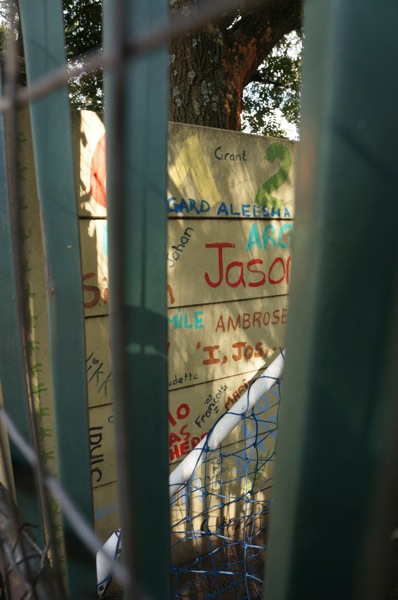
Children's names on the Foundation school's wall
We arrive at the front of Melpark school. The entrance is on 2nd Avenue, a tall steel gate fronting a traditional metal-roofed complex of colonial buildings complete with turret. There are hand-made posters protesting sexual violence tied to the railings and taped to the windows, a school project, no doubt. Nel speaks of the time her own children went to the school, of the difference a good headmaster and school administration makes to the upkeep of the school and the quality of teaching, which is very different between this school (scruffy and poor) compared to the Foundation school on 1st Avenue. I wonder how much oversight there is, and what a difference the wealth of the parents makes, but I can see that this school is not doing well. It has an air of neglect, a lack of care and love.

Walking further up 4th Street we admire some of the old-style Melville houses, their simplicity with a green corrugated iron roof, a covered stoop furnished with a sofa, a table, some plants in pots. Many houses up here are not hidden behind a high wall, so we can peek into front gardens, some of them ingeniously decorated with flags, cacti, gravel paths, a cat.

We have reached 1st Avenue, with its second primary school, a neat little art deco brick building fronted by a cleanly-swept playground. The wall bordering the playground is decorated with the names of the kids, all written out in their own hand, some scrawled, some neatly printed: Jason, Johann, Grant, Ambrose, Francois, Marie, Jikk… Amongst the names exhortations to 'Smile!', 'Be Happy', green stars and red hearts.
“The suburb of Auckland Park starts in the middle of this road,”
 Nel points out
“but that is disputed by some, just like the borders to Emmarantia and Westdene.” 

Melville is a desirable neighbourhood now, so everyone wants to be in it.

130310 Melville Walk 34
Deco elements gone wild

We follow 1St Avenue to 7st Street, walking past a series of quaint houses, one so stuck full of plaster decorations and fake Victorian cast iron frippery, it is hard to see the house underneath. The owners run a reclamation company and the house looks like whatever they couldn't or didn't want to sell, they stuck to the walls. Another house is an immaculate reconstruction of the colonial houses we saw in Matjesfontein, down to the sweeping metal roof topped with fine cast iron lace edges and filials. Another, much extended, property is clad in dark wood planks to look like a home straight from the Bavarian hills, window shutters, gables, doors and all. It is only missing the geranium flower pots to complete the picture.

130310 Melville Walk 40

We stop again on the corner of 7th and 4th, Nel pointing out the Scala barber shop that has been here for 45 years, and the butcher (Fresh Meat) that closed a while back, which used to deliver a daily order, with all accounts settled at the end of the month. The book shop next door to the butcher - Out of Print Books - has recently moved to 44 Stanley, and is still going strong.

130310 Melville Walk 75
One more church steeple
We finish the tour with a short walk across the Koppies, the nature reserve bordering Melville. It's a sudden shift from suburb to wilderness, a different view of the city, like the new view of Melville Nel has given us in the last few hours.


Nel's walk through Melville takes place once a month on a Sunday. You can reach her by email. Nel also arranges personal tours to Soweto and Pretoria.

25 March 2013

Jozi Walking - Part 1

130209 Yeoville and Ponte 101
The other day someone asked me about walking tours in Jozi. Since I have attended a few and plan on taking more, and they are such a thing here, I thought I would write a series of posts about the different kind of walks you can take part in when you are in Jozi.

130310 Melville Walk 48
Discovering Melville's back alleys
I have to explain first to those non-Jozi people why visitors and locals don't just go for a walk, why they congregate in groups to explore a part of town. Most obvious there is the perceived danger of visiting some of the suburbs with less than salubrious reputations, like Hillbrow and Yeoville. With South Africa's turbulent history, it is not surprising that some areas of the city have at one point or another been no-go zones.

Then there is the strange suburban separation that means people are unfamiliar with other parts of town. Massive changes have taken place in this city since the end of Apartheid, making locals unfamiliar with their own home city. A hip neighbourhood might have become run-down, and businesses have fled parts of the city wholesale, and are just recently returning. It is disorienting and creates uncertainty.

And there is the usual reason for going on a walking tour: to get a knowledgable local guide who will illuminate a neighbourhood beyond the obvious.

130209 Yeoville and Ponte 33
Hillbrow Introduction
My friend Heather on her blog frequently writes about Jozi tours. It's a good place to start. My previous posts about walks are here and here. And as a first introduction, here are a few tour guides and organisations offering walking tours of one kind or another. Get walking!


More walking posts in the next few weeks.

19 February 2013

Ponte Inside-Out

130209YeovilleandPonte-51-2013-02-19-12-58.jpg
Ponte from afar

Last week I had the opportunity to visit the inside of Ponte City Apartments, one of Joburg's landmark building on the edge of Berea and Hillbrow. The Ponte tower stands high on a hill, a tubular masterpiece topped by a glowing magenta advert for Vodacom. Ponte was once voted second-most ugly building in Joburg. That seems unfair. Built by the 29 year old Rodney Grosskopff, Ponte has variously been called "a failed architectural attempt at avant-garde skyscraper living" and "a den of iniquity run by drug dealers and thugs".

That was during the sad days after the end of Apartheid, when whites left the CBD neighbourhoods and the area became a neglected dumping ground for immigrants and the poor. There was once a plan to turn it into a prison (as if it wasn't that already when the rubbish piled up inside the core to the 6th floor and whole storeys had been converted into brothels and shooting galleries).
130209YeovilleandPonte-206-2013-02-19-12-58.jpg
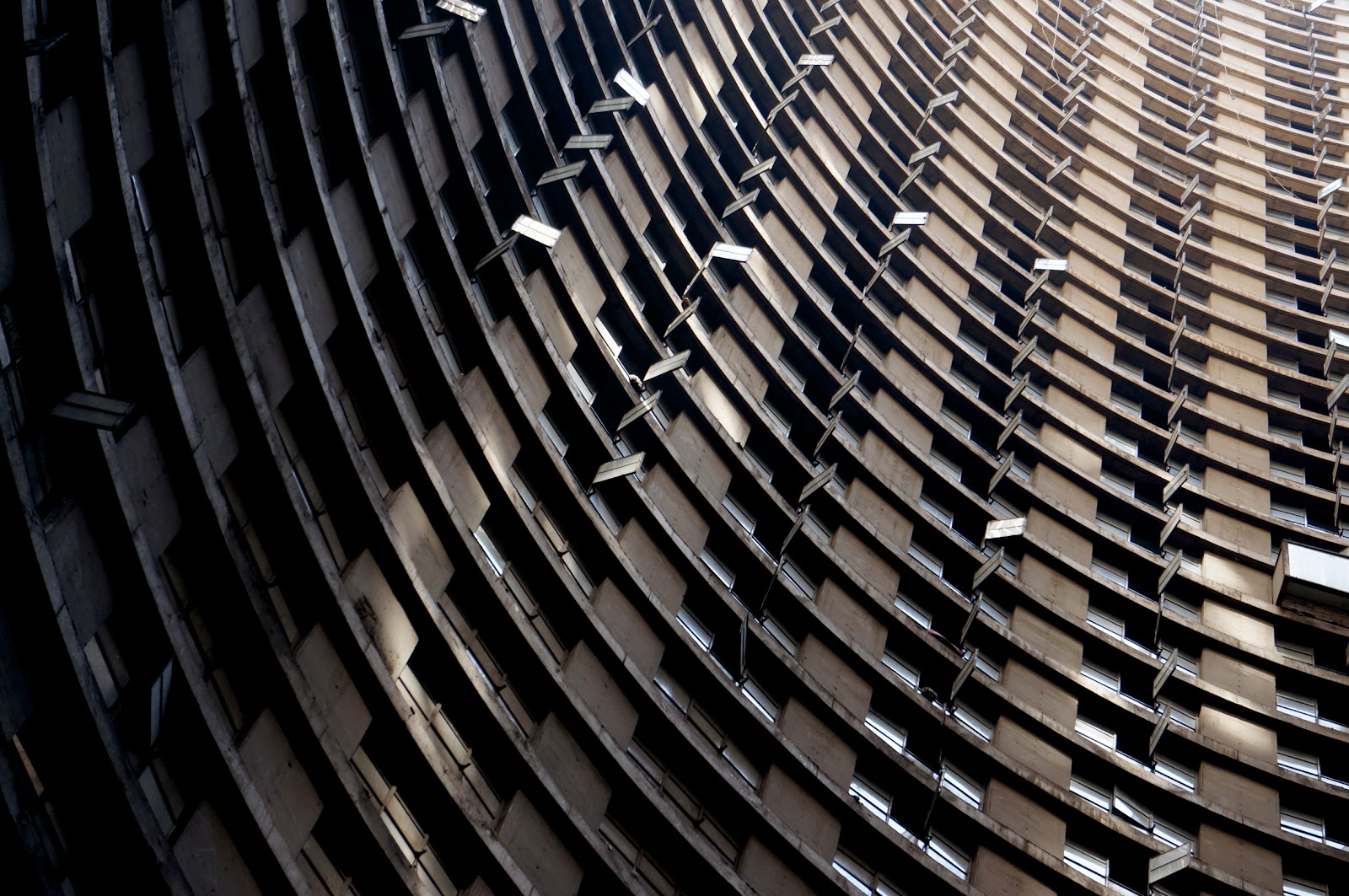
Inside the core, looking up at the hallway windows

At some stage there was a revival. The building was to be renovated from the ground up, with penthouse flats and flash furnishings. Plans for the unique, tubular core have included a climbing centre and a ski slope. There were financial wranglings, and then a recession, and it all fell apart. But, as if willing itself to be a symbol of the CBD's rebirth, there is now another, more sustainable initiative. The revamped ground floor with open spaces and clean shop floors will hopefully bring in paying visitors, a new biometric security system give a sense of safety, spanking new lifts replace the old creaky affairs.
I learnt all this only after my visit last week as part of the Yeoville walk. Now I am a little obsessed with the place.

130209YeovilleandPonte-196-2013-02-19-12-58.jpg
It's hard to stop looking up
Access to Ponte's core is actually open to all who dare. You just need to find the toilets in the shopping precinct and open the door to the internal stairs. We start by descending a decidedly skanky concrete staircase into the bowel of the hollow round interior of the skyscraper. While all the flats look out over the skyline of the CBD, the corridors give out to the inside of the tower. As we stand at ground level I am struck how the building clearly rises from the raw rock. It looks like a lava flow has solidified in the middle of the cavernous space. I first thought the fluid-looking slope was a torrent of composting refuse left from the previous state of disrepair, but then I realise it's designed like that. The image is of a human-built structure emerging from the bare rock as if extruded into existence.
130209YeovilleandPonte-193-2013-02-19-12-58.jpg
The building rising from bare rock

High up we can see clouds scudding past the circular blue cutout of the walls, but light barely reaches down here. The building partly sits on a two storey car park, a concrete grid letting in a little light from the side. We stumble across slippery slopes in the dimness, trying not to step into rubbish. Apparently the place is still abused as a quick disposal unit: egg shells, condoms, nappies, the usual. The space reminds me of the Gasometer in Oberhausen, a former gas tank repurposed into an art space. That space is lidded, and nowhere near as tall, but with the same feeling of infinity, of air and light bouncing off a circular space.
130209YeovilleandPonte-202-2013-02-19-12-58.jpg
A tiny glimpse of the sky from the base of the core

We ascend back to the ground floor to enter through the heavy security into the building proper. A serious looking guard behind a window, ID to show and a book to sign, a fingerprint scanner to operate the revolving gates - this place is as tight as Fort Knox. We ascend to a flat on the 52nd floor in one of the new lifts, padding covering the gleaming steel interior. Previously the flat was a two storey penthouse apartment - we can still see the stairs going nowhere next to his front door - but now it is a two-bedroom loft with a large open-spaced living room/kitchen. He is sharing with another person, bedroom off either side of the living room for privacy, and pays R5400 per month! The view, of course, is stunning. The windows open, giving a frisson of vertigo when I hold out my arm to take a photo. Fresh air wafts in with the view across the south of Jozi, a unique vantage point.
130209YeovilleandPonte-224-2013-02-19-12-58.jpg
The view from the 52nd floor

Much has been written about Ponte by people who are more knowledgable than I am about Jozi's recent history. It makes me think that the building, standing prominently on Jozi's skyline, is considered a cypher for something bigger, a hope of renewal, a marker in history. My obsession grows.
130209YeovilleandPonte-184-2013-02-19-12-58.jpg
A human being for size comparison
Update April 2012: I discovered a poetic little film about Ponte

Also, another article has the strange assertion that the design has flats for whites looking out and flats for black servants looking into the core of the building. As far as I could see all the flats had views to the outside, and the windows overlooking the inner core lined the corridors. Am I missing something?

09 February 2013

This day in history: Photowalks

Photowalker at the wishing tree
This is going to be a new series of post. Why? Because I have not blogged when things happened, so now I write about them in hindsight. That way I don't feel that I am so very very late with my writings, and I can still talk about the events I want to talk about... 

Cinema becomes church - suspension of disbelief continues
I can see that a year ago this month I went on my first and second photo walk. For those not in the know, the photowalkers are a Johannesburg group (do they exist anywhere else? I have never noticed them before, but who knows...) of amateur and pro photographers who walk the streets of Joburg and its surrounds in search of a good shot. The group has been going since 2009 and was founded by Mark Straw, who seems to have an indefatigable enthusiasm for devising new and interesting places to visit. 

Giving out New Year's good luck charms

Chinese New Year

My first event was the Chinese New Year celebrations in Bronkhorstspruit at the Nan Hua Temple. Heather, who first mentioned the whole photowalker concept to me, assured me that everyone would be friendly, and that she would introduce me. As it turned out we never even met any photo walkers, although they were surely there, because the temple was crowded with visitors.

All kinds of food for sale
The centre square of the temple was used for dragon puppetry, fireworks and general celebration, while the walkway around the square was crammed with stalls selling everything from massages to orchids, swords to dumplings. The temple itself was a quiet centre of the proceedings, where we could sit and take things in. 
Just outside the front entrance was a wishing tree festooned with ribbons where people left their wishes for the new year. Photo opportunities abounded. Even though we didn't meet the photo walkers, we came away with a haul of good pictures.

Art Deco Photowalk


The splendid Benoni Springs Fire Station (thanks, Anonymous)
It was on the next photowalk where I really got into the whole thing. Meeting in the morning at a mall in East Joburg, about twenty people divided up into cars for the ride out to Springs for the first part of an architectural tour of Joburg's satellite towns. 

Photowalker in action
A local architect showed us the art deco treasures of Springs: the town hall, local schools and private houses, and on the main street a cinema turned church as well as rows of shops and warehouses - all sporting fabulous Art Deco styling. 

Glorious Art Deco in Benoni
We ended up at a locally famous ice cream parlour where we got to go into the inner sanctum, where the delicious ice cream was made. The rest of the day was spent at Benoni where a splendidly designed fire station kept us occupied for quite a while. 

I spend a lot of time walking around cities (and the countryside) photographing what I see. I guess that makes me an urban photographer. The difference between going for a walk on my own and a photowalk is like night and day: In a group there is the challenge to catch that shot that no-one else did, find an angle that no-one else has. 

But it's not just competition. In a new place I am always fascinated when I see someone else take a picture. I creep up behind them and try to work out if they have discovered an interesting subject, what it is they are looking at. On a photowalk that is multiplied, because we all stand behind each other looking at the others' shots, wondering if we can capture something worthwhile, but different. It's a constant pushing and intensifying, scrutinising and questioning of the current view point. What else is there? How else can I capture this? What am I missing?

Want to go photowalking?

Blast from the past - analog photos
A Pentax K1000 in the wild
Photowalkers also use a wide range of cameras. There are the standard digital SLRs equipped with a range of lenses from fish eye to telephoto, but there is also the iPhone, the Helga, the old-school Pentax K-1000 with an external view finder. There is a refreshing lack of snobbishness around equipment, a mutual interest in each other's choices.

Best thing about photowalking? Going to places I either didn't know existed, or wouldn't have been brave enough to visit by myself. Joburg photowalkers are on Meetup, and as it turns out so are a bunch of other photowalking groups, so there is no excuse not to get involved.

More photos here: 

2012 Chinese New Year


www.flickr.com
fiverlocker's 2012 Chinese New Year photoset fiverlocker's 2012 Chinese New Year photoset

Art Deco Photowalk


www.flickr.com
fiverlocker's Art Deco Photowalk photoset fiverlocker's Art Deco Photowalk photoset