
We meet at Nel's house in a quiet cul-de-sac off already quiet 4th street. We are only six, this being Nel's first walk after a long hiatus. Nel is a retired history lecturer, having taught the 'History of the Struggle' at Soweto university. She starts with an introduction to Melville:
“This is one of Johannesburg's oldest neighbourhoods. It has ten streets and eleven avenues on a hilly grid. The land was given by the philanthropist Louwrens Geldenhuys, who owned the Braamfontein farm. The suburb was named after Edward Harker Vincent Melville, the surveyor. The developer created a lot of small stands, mainly bought by Afrikaaner manual workers who had been displaced by the British scorched earth policy during the Anglo-boer war. These people didn't have much bargaining power, they were unskilled farmers.”
These were not the large stands of some other suburbs that boasted stables and farm land, Nel points out, but small plots right up to the street.
As we wander up 4th Street, Nel points out what she calls 'catapult trees'.
“Melville was developed before the advent of electricity in Joburg. When power lines were put in the trees were in the way. Instead of cutting them down they were trained to grow on either side of the cables. Unfortunately often one branch grows stronger than the other and the weaker branch breaks off eventually, making for many lop-sided trees."
 |
| A Cape Dutch house fronted by a catapult tree |
We pass some beautiful and crazy houses, one a row of Cape Dutch white gables, and another that is enclosed in a green-painted high wall, the entrance overshadowed by a seemingly pointless slab of concrete cantilevered high over the door. Nel explains that there are no restrictions on the style of building that can be erected in Melville, unlike some of the posher suburbs, which are heavily prescribed as to shape, and size, style and even height of walls and style of gate.
Our first stop is the Melville Kruisgemeente church (a Dutch Reformed church), a large red-brick building with accompanying hall. The church is built in the 20s in the Art Deco style on the site of an earlier church hall from 1913, the first of three Dutch reformed churches we are to visit on this tour.
 |
| Melville spires - How many can you count? |
I am realising that I am the only Non-South African on this tour when Nel asks what the name of the hall might be, considering it was built in 1961. I am clueless. What could the construction date have to do with the name? Jonathan immediately says:
“President's Hall.”
Eh? Nel explains:
"Until 1961 we were a Crown colony, so everything was called Royal this and that. After 1961 we became a republic. Since then it's President's this and that instead.“
Shows what little knowledge of South African history I have.
We cross the road to walk past the simple white hall of the Methodist church, built to accommodate an alternative flavour of Christianity primarily patronised by the English. This style of simple long building, unadorned and plain, makes it easy to imagine the uncomplicated lives people lived here. Nel tells us about the way that churches and schools were the centre of the community, where people would meet each other, where events were organised and the community formed.
 |
| The entrance to Melpark primary school |
Walking around the corner we contemplate the changes that have taken place in Melville looking at the Melpark primary school, a large complex of old and new buildings and playgrounds backing onto 4th Avenue. We are looking at the back of the school, an unkempt block of red brick wall and building, stairs covered in garden waste and rubbish, a ragged fence keeping out intruders. Nel explains the history of the Melville schools:
"It used to be that when you had children, you would meet the other mothers at the baby clinic, then again when they went to the primary school together. It meant that you could get together, get support and help. Now the white kids go to the private schools in Linden and Emmarantia and the kids that go to the Melville schools are bussed in from Soweto. There is no local connection anymore. It started when the number of children dropped in the 80s.”
 |
| Painted wall at Melpark school |
Nel explains. The Afrikaans speaking school (Melpark) and the English speaking school (Foundation - we visit it later on 1st Avenue) merged for lack of students. When the schools opened to all races in '94, black children preferred the English-speaking school over Afrikaans-speaking teaching.
“Eventually the Afrikaans-speaking children moved to other schools where their language was given more emphasis, and eventually the English speaking white kids were moved out to other schools as well. Now there are no white children in the two school.”
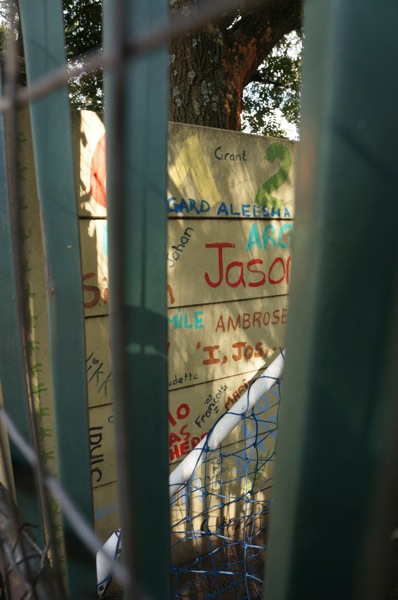 |
| Children's names on the Foundation school's wall |
We arrive at the front of Melpark school. The entrance is on 2nd Avenue, a tall steel gate fronting a traditional metal-roofed complex of colonial buildings complete with turret. There are hand-made posters protesting sexual violence tied to the railings and taped to the windows, a school project, no doubt. Nel speaks of the time her own children went to the school, of the difference a good headmaster and school administration makes to the upkeep of the school and the quality of teaching, which is very different between this school (scruffy and poor) compared to the Foundation school on 1st Avenue. I wonder how much oversight there is, and what a difference the wealth of the parents makes, but I can see that this school is not doing well. It has an air of neglect, a lack of care and love.
Walking further up 4th Street we admire some of the old-style Melville houses, their simplicity with a green corrugated iron roof, a covered stoop furnished with a sofa, a table, some plants in pots. Many houses up here are not hidden behind a high wall, so we can peek into front gardens, some of them ingeniously decorated with flags, cacti, gravel paths, a cat.
We have reached 1st Avenue, with its second primary school, a neat little art deco brick building fronted by a cleanly-swept playground. The wall bordering the playground is decorated with the names of the kids, all written out in their own hand, some scrawled, some neatly printed: Jason, Johann, Grant, Ambrose, Francois, Marie, Jikk… Amongst the names exhortations to 'Smile!', 'Be Happy', green stars and red hearts.
“The suburb of Auckland Park starts in the middle of this road,”
Nel points out
“but that is disputed by some, just like the borders to Emmarantia and Westdene.”
Melville is a desirable neighbourhood now, so everyone wants to be in it.
 |
| Deco elements gone wild |
We follow 1St Avenue to 7st Street, walking past a series of quaint houses, one so stuck full of plaster decorations and fake Victorian cast iron frippery, it is hard to see the house underneath. The owners run a reclamation company and the house looks like whatever they couldn't or didn't want to sell, they stuck to the walls. Another house is an immaculate reconstruction of the colonial houses we saw in Matjesfontein, down to the sweeping metal roof topped with fine cast iron lace edges and filials. Another, much extended, property is clad in dark wood planks to look like a home straight from the Bavarian hills, window shutters, gables, doors and all. It is only missing the geranium flower pots to complete the picture.

We stop again on the corner of 7th and 4th, Nel pointing out the Scala barber shop that has been here for 45 years, and the butcher (Fresh Meat) that closed a while back, which used to deliver a daily order, with all accounts settled at the end of the month. The book shop next door to the butcher - Out of Print Books - has recently moved to 44 Stanley, and is still going strong.
 |
| One more church steeple |
We finish the tour with a short walk across the Koppies, the nature reserve bordering Melville. It's a sudden shift from suburb to wilderness, a different view of the city, like the new view of Melville Nel has given us in the last few hours.
Nel's walk through Melville takes place once a month on a Sunday. You can reach her by
email. Nel also arranges personal tours to Soweto and Pretoria.


